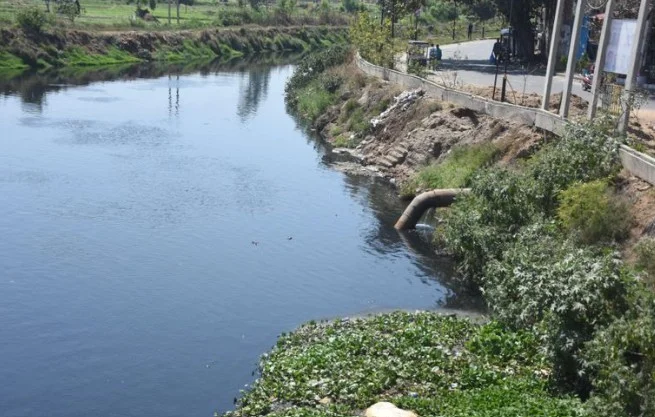


Ludhiana, Aug 11: Ludhiana’s fight against industrial pollution reached a critical stage as the National Green Tribunal (NGT) criticized the city’s dyeing industry and common effluent treatment plants (CETPs) for years of unchecked pollution and regulatory lapses. The tribunal’s recent directive, issued following petitions by the Public Action Committee (PAC), exposed repeated violations by three CETPs discharging treated effluent into Buddha Nullah, a water body burdened with domestic and industrial waste and linked to the Sutlej River, a key drinking water source.
The NGT ordered the Ministry of Environment, Forest and Climate Change (MoEF&CC) to complete its proceedings within two months. The Punjab Pollution Control Board (PPCB) must submit a comprehensive report detailing violations, environmental compensation, and recovery status. All involved parties are required to file compliance affidavits ahead of the next hearing on October 7.
Investigations revealed that three CETPs, with capacities of 15 million liters per day (MLD), 40 MLD, and 50 MLD, failed to meet environmental clearance conditions for years. These included non-implementation of Zero Liquid Discharge (ZLD), operating without consent, and unauthorized effluent discharge. The MoEF&CC confirmed that treated wastewater continues to flow directly into Buddha Nullah despite a Rs 10 crore environmental compensation penalty. The plants remain operational.
Bobby Jindal, chief of the Punjab Dyers Association, said, “There are nearly 300 dyeing units in Ludhiana and around 20 norms need to be followed by the CETPs. Generally, 17 to 19 guidelines are fulfilled, but all 20 are not met.”
He added that infrastructure shortcomings contributed to the issue. “The original plan was to discharge treated effluent into Lower Buddha Nullah, about 22 kilometers away, stretching to Moga, but the channel was never built. As a result, the waste continues to flow into Buddha Nullah.”
Newly appointed Industry Minister Sanjeev Arora said resolving the problem was his top priority. “An action plan for constructing the discharge channel is ready. It will soon be submitted to the government for approval,” he said.
A MoEF&CC audit uncovered further management gaps, including lack of online monitoring, absence of Memorandums of Understanding (MoUs) with member industries, unauthorized hazardous waste generation, and insufficient compliance reporting.
Repeated attempts to contact PPCB Chief Engineer Raj Kumar Ratra were unsuccessful.
Kapil Arora of the Public Action Committee described the NGT’s order as a turning point. “It confirms years of administrative failure and shows the impact of citizen-led efforts demanding accountability,” he said.
The case calls for coordinated action to address pollution in Buddha Nullah and protect critical water sources from industrial waste.