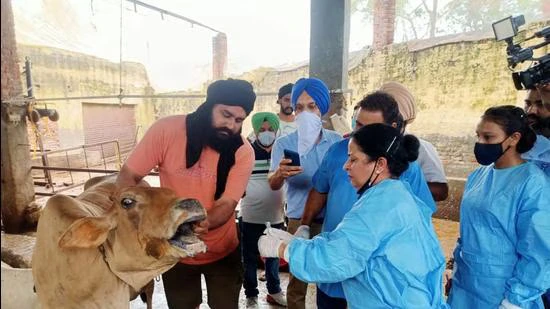


Chandigarh, Dec. 23 — The Punjab Animal Husbandry Department capped 2025 with large-scale emergency operations and long-term sectoral reforms, led by a round-the-clock response during floods that hit 12 districts of the state.
Animal Husbandry, Dairy Development and Fisheries Minister S. Gurmeet Singh Khudian said the department deployed 492 rapid-response veterinary teams across 713 flood-affected villages, treating more than 3.19 lakh animals free of cost.
“Our teams worked continuously on the ground, not only treating sick animals but also preventing the spread of disease. Protecting livestock meant protecting the backbone of the rural economy,” Khudian said.
As part of preventive measures, the department administered over 2.53 lakh booster doses of Hemorrhagic Septicemia vaccine to avert outbreaks. In coordination with district administrations and NGOs, officials distributed more than 20,000 quintals of cattle feed, over 16,000 quintals of silage, large quantities of fodder and straw, 234 quintals of mineral mixture, over 68,000 doses of dewormers and 194 kg of potassium permanganate. A total of 1,619 awareness camps were also held for livestock farmers.
Beyond flood relief, Khudian said the department strengthened veterinary infrastructure by procuring 22 modern animal lifters for state polyclinics. Six veterinary polyclinics in Gurdaspur, Patiala, Ludhiana, Sangrur, Sri Muktsar Sahib and Amritsar were upgraded with new indoor patient departments.
The department also expanded disease prevention, administering 24.27 lakh free doses against Lumpy Skin Disease, 126.22 lakh doses against Foot-and-Mouth Disease and 68.88 lakh doses against Hemorrhagic Septicemia.
At the Patiala Veterinary Polyclinic, a digital radiography system costing Rs 54 lakh was installed, enabling instant diagnosis of fractures, bone disorders and internal complications.
“This facility was earlier available only at the veterinary university in Ludhiana. Now farmers can access advanced diagnostics closer to home,” Khudian said.
In fisheries, the department provided Rs 5.82 crore in subsidies to 187 beneficiaries during 2024-25. Fish farming covered 43,683 acres, producing over 2 lakh tonnes of fish, while shrimp farming yielded 2,550 tonnes across 985 acres. More than 9,200 people were trained in fisheries practices.
In the dairy sector, around 8,500 farmers were trained annually, leading to the establishment of nearly 3,500 dairy units each year. Under the National Livestock Mission, 30,734 milch animals were insured, with Rs 9 crore disbursed to farmers who suffered cattle losses.
Principal Secretary Rahul Bhandari said, “This year reflected our commitment to serving farmers during crises while building a scientifically advanced and resilient animal husbandry sector for Punjab.”