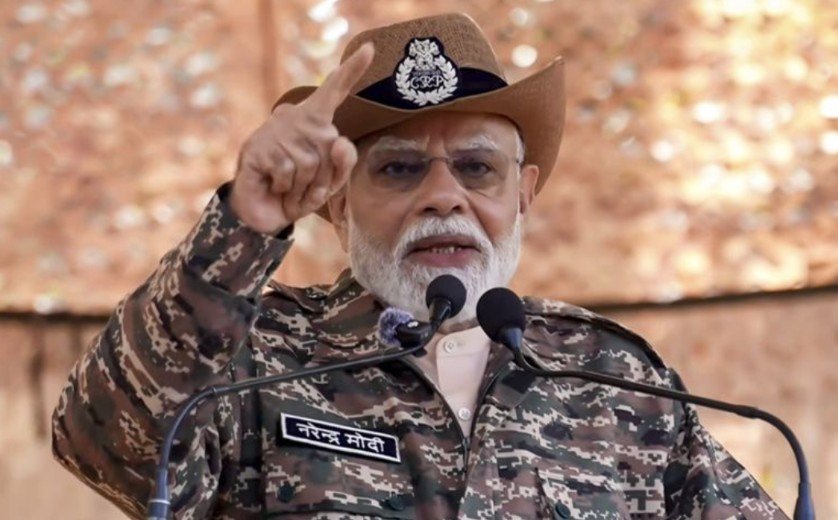


JAGDALPUR, NOVEMBER 11: Prime Minister Narendra Modi has warned that although armed Maoist insurgency has been significantly weakened, the threat posed by what he described as “Dimagi Naxals” continues to persist, alleging that such ideological elements have infiltrated several political parties and organisations and are instigating people against the Constitution and democratic institutions.
Addressing security personnel during his Diwali visit to a CRPF camp in Karanpur, in Chhattisgarh’s Bastar region, the Prime Minister said that the country must remain vigilant against ideological supporters of Naxalism, even after the elimination of armed Maoist groups from several affected areas.
“Armed Naxalites have disappeared from the forests, but ‘Dimagi Naxals’ have taken control of several organisations,” Modi said, adding that such elements were allegedly encouraging people against the country’s Constitution and democracy.
He called upon the people and institutions to identify and defeat such forces, asserting that safeguarding national security and democratic values remained a priority.
The Prime Minister said that the elimination of Maoist terrorism was the outcome of strong political determination, security measures and what he described as the government’s right policies.
Referring to the government’s announcement on March 31, 2026, regarding the country being free from Naxalism, Modi maintained that the ideological challenge had not completely disappeared.
RECALLS YEARS OF NAXAL VIOLENCE
Recalling the history of Left-Wing Extremism in the country, the Prime Minister said that at one point more than 230 districts across nearly 20 states were affected by Naxal violence.
He said thousands of villages and millions of people had experienced the consequences of insurgency, with around 2,000 Naxalite attacks reportedly taking place annually during the peak period.
Modi criticised previous governments, alleging that between 2004 and 2013, security personnel continued to lose their lives in large numbers while the threat remained inadequately addressed.
He said the situation began changing after 2014, with improved operational freedom for security forces and stronger action against Maoist networks.
PRAISES CRPF AND SECURITY FORCES
Highlighting the role of security personnel, Modi said that for the first time in 47 years, not a single CRPF personnel had lost his life while on duty during the preceding year.
He described the achievement as a reflection of the courage, determination and commitment of security forces engaged in counter-insurgency operations.
The Prime Minister also said that his government had taken several important decisions to strengthen national security and disrupt the financial networks allegedly supporting Naxalites and secessionist elements.
According to Modi, action against fake currency networks and financial channels had weakened the supply of weapons and recruitment mechanisms of Maoist groups.
FOCUSES ON DEVELOPMENT AND NATIONAL SECURITY
The Prime Minister said the government’s objective was to ensure that no family suffered the loss of a loved one due to violence, no child was forced to take up arms and no young person lost their future to extremism.
He maintained that alongside security operations, development initiatives and public outreach had helped transform lives in areas previously affected by Naxalism.
Modi also referred to India’s progress in poverty reduction, citing a World Bank report which, according to him, indicated that around 50 crore people had moved out of extreme poverty over the past 12 years.
Referring to major national initiatives, he cited the abrogation of Article 370, expansion of household sanitation facilities and vaccination coverage as examples of the country’s capacity to achieve challenging national objectives.
The Prime Minister expressed confidence that India would also achieve its goals of eliminating poverty, building a drug-free society, becoming self-reliant and emerging as a developed nation.
He reiterated that national security, democratic institutions and the country’s constitutional framework must be protected against all forms of extremism.