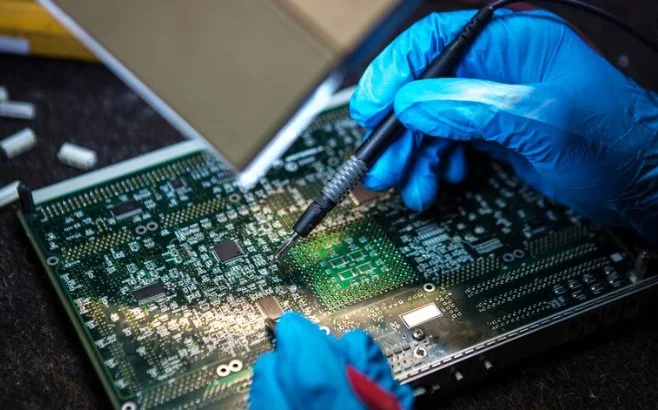


Chandigarh, August 20: The Union government will modernise and expand the Semi-Conductor Laboratory (SCL) in Mohali to strengthen India’s push for self-reliance in chip manufacturing, Union Minister of State for Electronics and Information Technology Jitin Prasada told Lok Sabha on Wednesday.
Responding to a question from Chandigarh MP Manish Tewari, Prasada said the move comes under the Semicon India Programme, which carries a total outlay of ₹76,000 crore. “SCL employees are an integral part of this modernisation process,” he noted.
The laboratory, originally set up in 1976, was transferred to the administrative control of the Ministry of Electronics and Information Technology (MeitY) on February 7, 2022, following inter-ministerial consultations that included the Department of Space. According to the minister, the upgrade will allow SCL to serve both strategic requirements and emerging commercial needs, with Indian start-ups and academic institutions already fabricating chips at the facility.
“So far, 56 designs from 34 institutions have been taped out under the Chips to Startup (C2S) Programme at SCL. Fabrication has been completed for 28 chips designed by 25 academic institutions,” Prasada said.
The minister underlined that SCL continues to play a critical role in meeting the needs of the Department of Space and ISRO. He added that the overall objective is to give the Mohali unit a larger role in India’s semiconductor ecosystem. “India’s semiconductor strategy is comprehensive. It aims to develop a complete ecosystem, ranging from design, fabrication, assembly, testing, packing and manufacturing. India is focusing on developing a deep talent pipeline,” he said.
However, Tewari expressed dissatisfaction with the government’s reply. “It is unfortunate that a comprehensive question on SCL — perhaps the first-of-its-kind — has met with a motherhood and apple pie response from the government,” he remarked.
The Congress MP warned that ignoring existing challenges could undermine India’s semiconductor ambitions. “SCL is critical to the success of India’s semiconductor chip-making ambitions. It is facing myriad challenges, including low morale among the scientific community because of serious salary and pension issues,” Tewari said.
Recounting the history of the facility, Tewari added, “Semi-Conductor Limited in Mohali was set up in 1976. There was a mysterious fire on February 7, 1989, that many believe was the handiwork of Pakistan’s ISI and at the behest of its western masters. This was designed to set back India’s pioneering efforts in chip making, which at that point of time was way ahead of the US and even Taiwan.”
Government officials maintained that the laboratory already undertakes a range of specialised functions. The Mohali facility handles design development, fabrication, assembly, testing, packaging and quality assurance of silicon CMOS and MEMS devices. It manufactures integrated circuits such as voltage regulators, references, switches, data converters, amplifiers, drivers and application-specific integrated circuits (ASICs), which have applications in space and other strategic sectors.
Semiconductor manufacturing, officials noted, is a “foundational and strategic industry, vital for national development.” Chips are required in products ranging from mobile phones and refrigerators to automobiles and missiles. With electronics manufacturing on the rise, India sees chip production as indispensable for achieving self-reliance.
Prasada said the government’s semiconductor programme is inspired by Prime Minister Narendra Modi’s vision of Atmanirbhar Bharat, Make in India and Make for the World. “It builds on the design capabilities in our country,” he mentioned.
Experts argue that the sector requires sustained capital investment, large-scale infrastructure and highly skilled manpower. Chip fabrication itself depends on more than 300 specialised gases and chemicals. The Centre’s plan, officials said, seeks to address these gaps by positioning SCL as a core pillar of the national semiconductor ecosystem.