

New Delhi, October 14 — India and Canada on Monday unveiled a new roadmap to reset and rebuild their relationship after a year of diplomatic chill, agreeing to restore high-level dialogues and expand cooperation across trade, technology, energy and education.
The announcement came after talks between External Affairs Minister S. Jaishankar and Canadian Foreign Minister Anita Anand, who is on a three-day official visit to India from October 12 to 14.
“Our responsibility as Foreign Ministers is to shepherd the process of rebuilding our cooperation and ensure it delivers on the expectations of our Prime Ministers and the interests of our people,” Jaishankar said, stressing that India’s foreign policy seeks to “de-risk the international economy” by strengthening partnerships with like-minded democracies.
Jaishankar described Canada as “a complementary economy and an open society that values diversity and pluralism,” saying this formed the foundation for a “close, sustainable and long-term cooperative framework.”
Anand, thanking India for the warm welcome, said her visit reflected both nations’ resolve to “elevate the bilateral relationship” under the joint roadmap agreed upon by Prime Ministers Narendra Modi and Mark Carney at the G7 summit in Kananaskis. “This framework makes clear to our citizens that both governments are collectively committed to advancing this relationship now and in the long term, particularly in the Indo-Pacific,” she said.
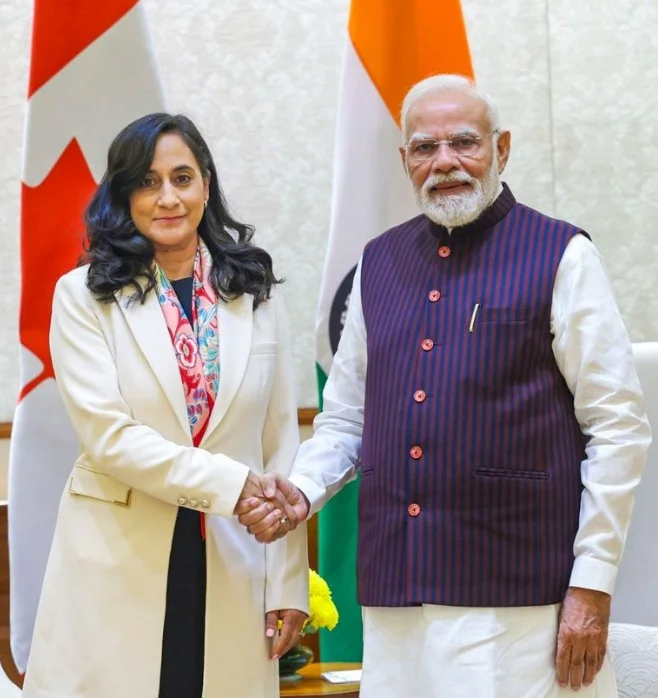
Earlier, Anand called on Prime Minister Modi, who said her visit would “contribute to imparting new momentum” to the bilateral partnership. Modi underlined the importance of deeper cooperation in trade, energy, agriculture, technology and people-to-people ties.
Following their talks, the two foreign ministers issued a joint statement reaffirming commitment to the principles of sovereignty, territorial integrity and the rule of law — and emphasising that a strong partnership between the two democracies was essential amid global uncertainty.
The new roadmap builds on recent high-level engagements, including the reinstatement of High Commissioners, NSA-level meetings in New Delhi, and discussions on law enforcement and security cooperation.
Both sides welcomed the rise in bilateral trade — which touched $23.66 billion in 2024 — and agreed to resume ministerial-level trade and investment talks soon. The Canada-India CEO Forum will be relaunched in early 2026 to connect leading business figures in clean technology, infrastructure, agri-food and digital innovation.
Recognising climate action as a shared priority, India and Canada will also revive the Ministerial Energy Dialogue to boost cooperation on clean energy, LNG and LPG trade, green hydrogen and carbon capture. The first Canada-India Critical Minerals Dialogue will be held in Toronto in March 2026 to strengthen India’s access to key resources for its energy transition.
In technology, both countries will revive the Joint Science and Technology Cooperation Committee, promoting collaboration in artificial intelligence, digital infrastructure and cybersecurity. Canadian researchers and startups are expected to join India’s AI Impact Summit in February 2026.
Calling people-to-people exchanges the “bedrock” of the partnership, the two ministers agreed to expand cooperation in education, research and mobility. A revitalised Joint Working Group on Higher Education will guide university partnerships and enable overseas campuses in India.
Jaishankar and Anand also directed their respective missions to enhance coordination across political, economic, defence and technology domains to ensure effective implementation of the new roadmap.