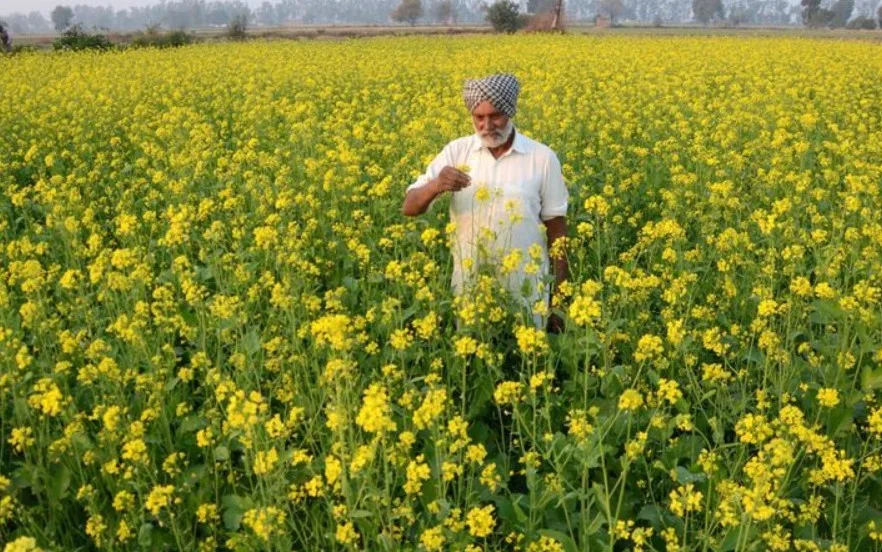


CHANDIGARH, Dec 25: Punjab’s mustard fields, once a defining feature of its rural landscape, are steadily disappearing as farmers avoid the crop due to uncertain profits and poor marketing support, even as mustard oil prices continue to rise nationally.
The area under oilseed cultivation in Punjab has dropped sharply over the decades. From nearly 5 lakh hectares between 1970 and 1975, oilseeds now cover only about 51,000 hectares in the state. Mustard alone accounted for roughly 41,000 hectares last year, according to agriculture department data.
As a result, Punjab produces only about 3% of its edible oil requirement, forcing the state to depend on imports for the remaining 97%.
“Farmers are not unwilling to grow mustard, but the lack of assured procurement makes it risky,” said Gurmail Singh, a farmer from Maddoke village. “Last year, I earned good returns from mustard on 25 acres, so I expanded it to 40 acres this season.”
Singh said he harvested nearly 16 quintals per acre, higher than the average yield of 6 to 8 quintals per acre reported across the state.
Despite such examples, most farmers continue to favor wheat and paddy due to well-established government procurement systems. Mustard’s Minimum Support Price stands at around Rs 6,200 per quintal, but farmers say MSP has little meaning without guaranteed buying.
“There is no government procurement for mustard,” said Jaspal Singh of Charik village, who sowed the crop on 2.5 acres this year. “Private traders decide prices on their own terms.”
Ramanpreet Singh from Badhni Kalan echoed similar concerns, saying he increased mustard acreage marginally this year but remains cautious. “Seeds are expensive, and marketing is uncertain. If these issues are addressed, more farmers will shift,” he said.
The ideal sowing window for mustard runs from late September to the end of October, though some varieties can be planted until late November. Brown and yellow mustard, Raya-Toria and Gobhi Sarson are commonly grown in Punjab.
Rajasthan remains the country’s largest mustard producer, followed by Uttar Pradesh, with Gujarat, West Bengal, Haryana and Assam also contributing significantly. In Punjab, Fazilka leads mustard production, followed by Hoshiarpur, Gurdaspur and Bathinda.