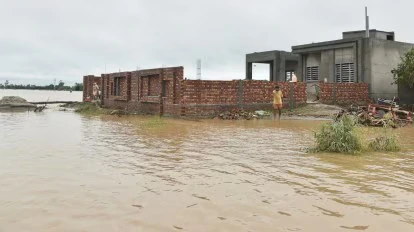


Chandigarh, Sept. 3: Punjab faces an escalating flood crisis as heavy rainfall across the state has caused rivers to swell, dams to near capacity, and low-lying villages to face imminent risk, officials said Wednesday. Authorities have issued multiple alerts, ordered evacuations in vulnerable areas, and mobilized disaster management teams to respond to the situation.
The India Meteorological Department (IMD) has forecast moderate to intense rainfall across several districts over the next three hours, raising concerns about flash floods, waterlogging, and river overflows. Districts under red alert include Kapurthala, Jalandhar, Nawanshahr, Rupnagar, Moga, Ludhiana, Barnala, and Sangrur.
In Patiala, authorities issued an urgent flood alert for Devigarh areas after the Tangri River rose close to the danger mark following heavy rain in upstream Ambala and Kala Amb. Officials warned that the river is expected to swell further in the next 10–12 hours, threatening villages along both banks. Villages likely to be affected include Mehmodpur Rudki, Devinagar, Harigarh, Rohar Jagir, Lelan Jagir, Dudhangujran, Adaltiwala, Maghar Sahib on the right bank, and Mohalgarh, Khansa, Rattakhera, Aujan, Khatauli, Ganeshpur, Kharabgarh, Bibipur, Jodhpur, Budhmor, and Sadikpur Biran on the left bank. Authorities advised residents to remain vigilant, avoid venturing near the river, and follow official instructions.
In Ropar district, the Bhakra Beas Management Board (BBMB) announced that 75,000 cusecs of water would be released into the Sutlej due to high inflows into Bhakra Dam. By Wednesday morning, the dam’s water level reached 1,678 feet, just two feet below the maximum permitted level of 1,680 feet. Inflows were recorded at 86,822 cusecs, while outflows stood at 65,042 cusecs. Villages including Harsa Bela, Bela Ramgarh, Sensowal, and Singhpura are being evacuated, as road connectivity has already been disrupted. Education Minister Harjot Singh Bains assured residents that safe shelter arrangements have been made. “People should move to safer areas immediately. Our teams are on the ground to assist with evacuation and relief,” he said. Officials also noted that Pong Dam is under pressure, with water levels exceeding its optimum capacity by three feet.
Political leaders have stepped into the relief effort. Punjab’s Rajya Sabha MP Raghav Chadha, who had remained politically inactive in the state for months, visited flood-affected areas in Gurdaspur last week atop a tractor and has now allocated Rs 3.25 crore from his MPLADS fund to assist flood victims.
Union Agriculture and Farmers Welfare Minister Shivraj Singh Chouhan is scheduled to visit flood-hit Punjab on Thursday to assess damage and coordinate relief efforts. Speaking on Wednesday, Chouhan said he had discussed the situation with Punjab Governor Gulab Chand Kataria and Chief Minister Bhagwant Mann. “I will reach Punjab tomorrow morning and meet my brothers and sisters in the flood-affected areas. In this hour of crisis, the Central Government stands firmly with the people of Punjab and will provide all possible assistance,” he said.
Authorities in Haryana’s border districts adjacent to Punjab, such as Yamuna Nagar and Ambala, have also been placed on alert due to the potential spillover from rivers crossing state boundaries. In Punjab’s Tricity, the Panchkula administration declared school closures for Wednesday as heavy rainfall has caused waterlogging, property damage, and traffic disruptions across key junctions and roads.
The combination of continuous rainfall, saturated soil, and rising river levels has made several areas extremely vulnerable. Disaster management officials have emphasized the importance of following evacuation orders and staying away from flood-prone areas. “The water levels are rising rapidly. Residents in low-lying areas should not wait and should relocate immediately to designated shelters,” a Punjab state disaster official noted.
Villagers along the Sutlej, Tangri, and other rivers have reported widespread concern as officials monitor dams and riverbanks closely. Many roads connecting rural settlements have already become impassable, complicating both evacuation and relief operations. Emergency teams are stationed at key points to provide assistance and supplies to affected families.
The ongoing rains have also heightened risks of flash floods in small rivulets and seasonal streams across the state. Authorities have issued advisories urging people to avoid crossing flooded roads or taking shortcuts through waterlogged areas. “Even shallow water can be dangerous during floods. Residents should stay indoors whenever possible and follow instructions from local authorities,” officials said.
The government has set up emergency shelters and relief camps in major affected districts. Teams are coordinating to ensure that essential supplies such as food, drinking water, and medical aid reach all those displaced by the rising waters. Meanwhile, authorities continue to evaluate dam levels, rainfall forecasts, and river monitoring data to anticipate further threats.
Punjab is now bracing for the next 24–48 hours, as meteorologists predict more rain in affected districts. The combination of swollen rivers, dams nearing capacity, and ongoing precipitation has prompted authorities to maintain high alert levels.
Residents have been urged to remain calm, cooperate with emergency services, and prioritize safety over property. Relief and rescue operations are ongoing, with teams working round the clock under challenging conditions to protect lives and minimize damage.