

OPINION / BY ACHARYA DR. VIKRAMADITYA
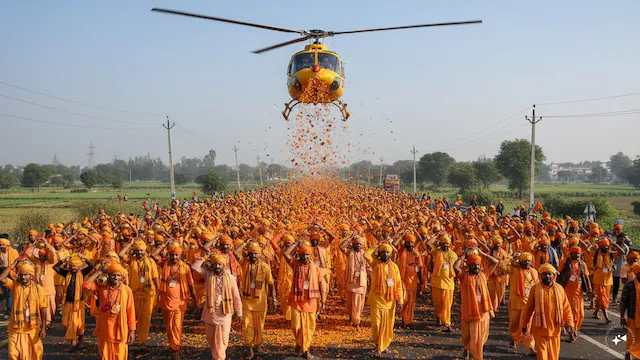
Absorb the sight of groups of Kanwariyas setting out with the sacred resolve of offering holy water to Lord Shiva. The same stream of faith and devotion is visible at the Mahakumbh in Prayagraj, in the temple complex of Lord Ram Lalla in Ayodhya, in the courtyard of the Banke Bihari Temple, and along the Kashi Vishwanath Corridor.
Today, the Kanwar routes present a living spectacle of the internal harmony, inclusiveness, and cultural renaissance of Hindu society. Centuries-old social barriers and inequalities seem to have dissolved in the sacred waters of faith.
Among the Kanwariyas are Brahmins, Dalits, OBCs, and Adivasis alike.
The Kanwar resting on one’s shoulder does not ask about caste, nor do community kitchens along the route distribute prasad only after verifying a person’s lineage or clan.
The Kanwar Yatra stands as a living map of the country’s social consciousness, with Uttar Pradesh acting as its foremost representative. Under the leadership of Chief Minister Yogi Adityanath, the state has emerged as a symbol of the reawakening of an inclusive Hindu society.
Thinkers who interpret Hindutva from a socio-cultural perspective regard the Kanwar Yatra as evidence of the intrinsic inclusiveness of Hindu society, citing the growing participation of Dalits and backward communities.
At the level of lived experience, the pilgrimage offers a new interpretation of theories of Sanskritization and cultural dominance. It demonstrates that in Sanatan culture, devotion to God is the natural right of every soul seeking to merge with the divine essence of Shiva. Shiva is Vishwanath and Bholenath not only for gods but also for demons, humans, spirits, and all beings alike. He bears poison in his throat to protect the universe and, as the generous ascetic, showers equal grace upon every devotee. Everyone walking the Kanwar route is simply a devotee of Lord Shiva, while social, economic, and caste identities fade into insignificance. As people from every section of society walk shoulder to shoulder, the walls of social inequality begin to crumble.
The Dalit and backward communities, once deprived of many social and cultural opportunities, have today become the backbone of this pilgrimage. One major reason is that the Uttar Pradesh administration has recognized them as rightful participants in an inclusive cultural framework.
The pilgrimage reflects both their unwavering faith in the Sanatan tradition and the acceptance of their natural claim to their cultural heritage. It also rejects the notion that the country’s cultural and religious symbols have merely served as instruments of upper-caste dominance.
When millions of young people from marginalized and backward communities become the principal standard-bearers of this grand expression of devotion to Lord Shiva, they demonstrate that the true foundation of Sanatan Dharma rests not on dominance but on coexistence and fraternity.
The spiritual equality championed during the Bhakti movement by saints such as Kabir, Ravidas, Chokhamela, and Kanakadas is today vividly reflected in the Kanwar Yatra, awakening a sense of self-respect, pride, and unity across every section of society.
This may well be described as the grandeur of Sanatan society made possible through administrative resolve, state support, and a conducive environment. In Uttar Pradesh, under the leadership of Chief Minister Yogi Adityanath, the Kanwar Yatra has evolved into a grand, secure, and dignified cultural festival. A decade ago, however, the state’s approach to the Kanwar Yatra was marked by neglect, administrative obstacles, security concerns, and an atmosphere of suspicion. The present government has fundamentally transformed this outlook.
The administration has sent a clear message that respecting people’s faith and ensuring every citizen has the opportunity to observe their religious traditions in a safe and dignified environment is one of the state’s foremost responsibilities. The flower showers on Kanwariyas, witnessed over the past few years, symbolize the state’s respect for the faith of its citizens. When flowers are showered upon devotees from helicopters, the spectacle instills a renewed sense of confidence and pride across society. The extensive arrangements made to ensure the smooth conduct of the Kanwar Yatra including safe and clean routes, medical camps, rest shelters, proper lighting, and adequate food and drinking water facilities for devotees reflect the belief that spirituality can serve as a powerful instrument of social empowerment and harmony. The spirit of selfless service displayed at the service camps along the Kanwar routes helps eradicate deep-rooted notions of social hierarchy and mutual hostility from within society.
Economic or political initiatives alone are insufficient to eliminate social inequality unless they are accompanied by a genuine sense of equality at the cultural and spiritual level. The Kanwar Yatra provides a practical platform for this spiritual egalitarianism. By extending grandeur, security, and respect to this platform, the state government has fostered a renewed sense of pride in Sanatan Dharma among the oppressed and marginalized sections of society. The magnificent scale of the Kanwar Yatra offers a glimpse of the country’s inner strength, a civilization that finds its essence in unity amid diversity and in social harmony. The pilgrimage also serves as an answer to those forces that seek to divide society along caste lines. This current of cultural awakening symbolizes the collective rise of the entire Hindu society, guiding Sanatan society towards its true ideals of ‘Vasudhaiva Kutumbakam’ and ‘Sarve Bhavantu Sukhinah’.