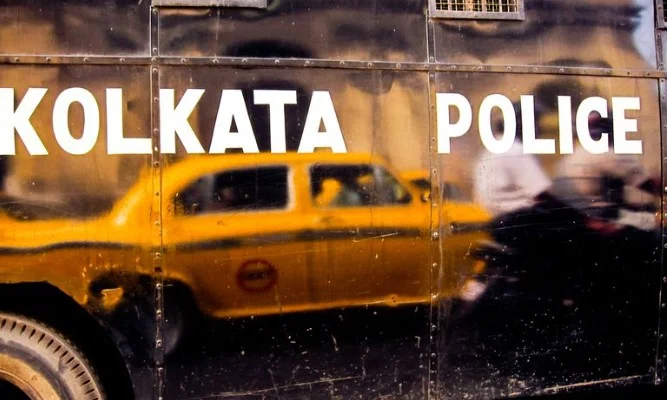


Kolkata, 16 August — A fresh controversy erupted in Kolkata on Saturday after the city police allegedly stopped the trailer launch of filmmaker Vivek Agnihotri’s upcoming movie The Bengal Files, a film based on the 1946 Calcutta Riots. The event was scheduled to take place at a five-star hotel in the afternoon, but police personnel present at the venue reportedly did not allow the programme to go ahead.
The trailer launch, which had been planned as the formal unveiling of the film ahead of its theatrical release on September 5, was abruptly cancelled, triggering sharp reactions from the director. “This is an attack on the democratic rights of people,” Agnihotri said in a statement, pointing out that the Central Board of Film Certification (CBFC) had cleared the movie for release and that the Calcutta High Court had recently stayed a ban sought against it.
Police officials at the venue refrained from commenting on the reasons for their intervention, and no official statement had been issued by the Kolkata Police till late evening. Eyewitnesses said security personnel asked organisers to discontinue the launch programme, but did not cite any specific order or legal reason. The abrupt move has raised questions over whether the action was administrative, political, or linked to law and order concerns.
The Bengal Files explores the communal violence that engulfed Calcutta (now Kolkata) and other parts of undivided Bengal in August 1946, commonly known as the “Great Calcutta Killings.” Historians estimate that thousands of people were killed and many more displaced during the riots, which deepened communal divisions on the eve of Partition.
Given the film’s subject matter and its director’s past work — Agnihotri had earlier made The Kashmir Files (2022), which stirred fierce debates over its depiction of the exodus of Kashmiri Pandits — the project has been viewed as politically and socially sensitive. Opposition parties in West Bengal have accused the filmmaker of “provoking communal sentiments,” while supporters argue that he is “bringing suppressed history to the fore.”
Earlier this month, a petition was filed in the Calcutta High Court seeking a ban on the film, with petitioners arguing that its release could “inflame tensions” and disturb communal harmony in the state. However, the High Court stayed any such ban, noting that the censor board had already cleared the movie and that “freedom of expression cannot be curtailed without lawful grounds.”
The CBFC has granted a certification for the film’s theatrical release, making Saturday’s police intervention even more controversial in the eyes of the director. “If a film is cleared by the censor board and protected by the judiciary, how can the police decide to stop its trailer launch?” Agnihotri asked.
The incident has reignited debates on freedom of expression, censorship, and political interference in cinema. Civil liberties groups and free-speech advocates have frequently criticised attempts to curtail artistic works on grounds of law and order. Filmmakers in India have often complained that even after securing censor board clearance, they face informal pressure or local restrictions that prevent screenings, particularly in politically sensitive states.
Despite the setback, Agnihotri has confirmed that The Bengal Files will hit theatres nationwide on September 5 as planned. He also hinted at moving court again if necessary. “We will not be silenced. If they stop us in hotels, we will reach people in other ways. The truth of Bengal’s history will come out,” he said.
For now, the controversy adds another layer of tension ahead of the film’s release, placing the spotlight on how Bengal’s political climate intersects with cinema and history. Whether the police action was a one-off disruption or the beginning of broader restrictions remains unclear.