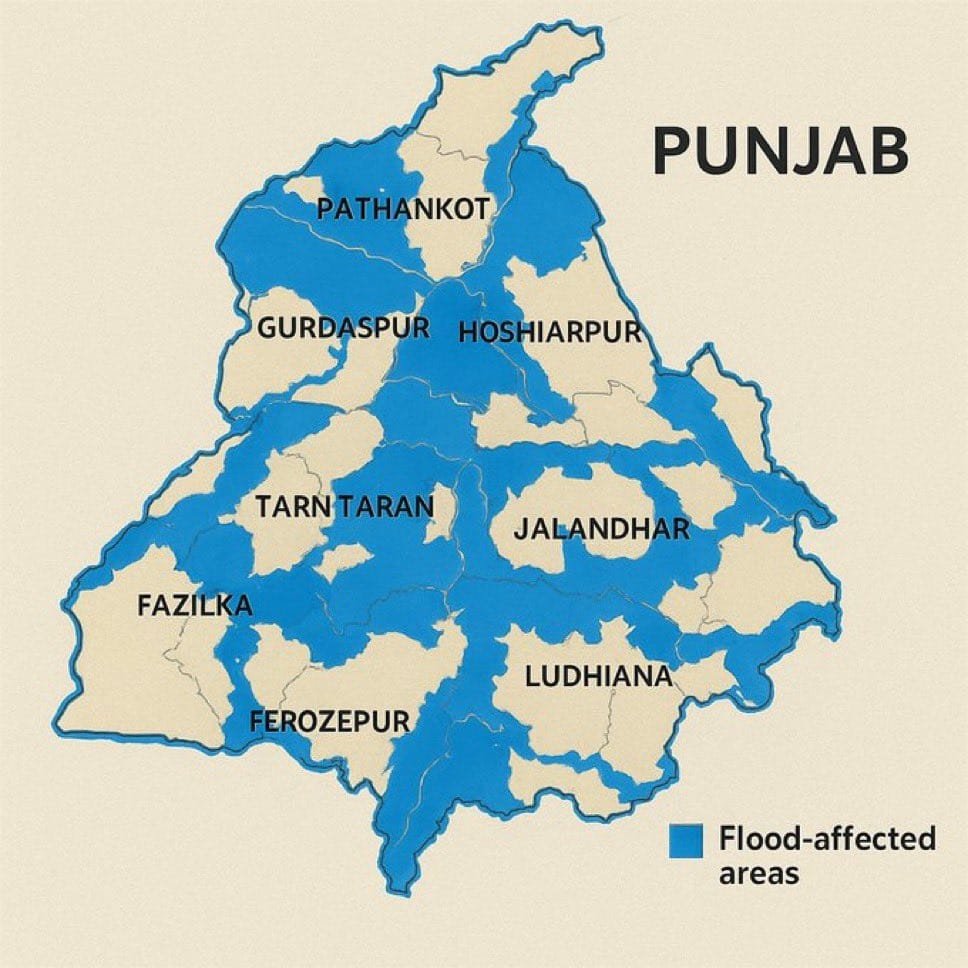


Chandigarh, August 28: Every monsoon, when heavy clouds burst over the mountains of Himachal Pradesh, anxious eyes turn downstream. For the people of Punjab’s border villages, rain in the hills often translates into rising waters, overflowing rivers, and submerged homes. The question is often asked: why does flooding in Punjab follow so quickly after rains in Himachal?
The answer lies in the rivers that connect the two states. The Sutlej, Beas and Ravi begin as gushing mountain streams in Himachal, but they do not stay confined there. They carry rainwater, glacial melt and debris down to Punjab’s fertile plains. “Punjab sits at the receiving end of these river systems,” explained a senior official in the state’s irrigation department. “Whenever rainfall is intense in Himachal, we know the surge is heading our way.”
In the mountains, rain runs off rapidly because of steep slopes. Unlike flat land, which can absorb some water, the hills channel it quickly into rivers. This surge swells downstream flows, often beyond what embankments in Punjab can contain.
Punjab’s geography adds to the problem. The state is largely flat, with low-lying stretches that act like a bowl once river waters spill out. Villages and farmlands on the floodplains, particularly in Amritsar, Gurdaspur, Ropar and Ferozepur, are among the first to go under. Farmers often say that their soil’s greatest gift — its fertility — becomes their greatest curse during floods.
The recent breach of the Dhussi bandh along the Ravi is just one example. Within hours of the embankment giving way, nearly 40 villages around Ramdass were inundated. Locals recall how the water came rushing in, leaving them barely enough time to gather belongings before the Army arrived with boats.
Punjab also feels the impact of large reservoirs in Himachal. The Bhakra Dam on the Sutlej and Pong Dam on the Beas are designed to regulate river flows, but they have their limits. When rainfall is unusually heavy, authorities must release water to protect the dams themselves. Those releases, though necessary, often add to Punjab’s flooding woes.
“People sometimes blame the dams, but without them the floods would be far worse,” said Professor Arun Grover, a water management expert based in Chandigarh.
“The problem is that our embankments and drainage in Punjab are outdated and cannot handle such volumes anymore.”
While geography explains the natural flow, human intervention has made Punjab more vulnerable. Unchecked construction on floodplains, encroachment on natural drainage channels, and weakening of embankments due to illegal sand mining all reduce the land’s resilience. “We have built on nature’s sponge,” noted environmentalist Sunita Narain. “When you replace wetlands with concrete, the water has no place to go but into people’s homes.”
Scientists warn that climate change is intensifying the monsoon. Instead of steady rain, South Asia now experiences sharp, concentrated downpours. In Himachal, cloudbursts and record-breaking rainfall events have become more common. That water, in turn, races downstream into Punjab.
“The hills are sending down more water in shorter bursts,” said Anjal Prakash, IPCC author and climate researcher.
“This is why Punjab is seeing repeated floods. It is no longer just about natural rivers, it’s about a shifting climate.”
For families in Punjab’s riverbelt, these patterns have become an annual nightmare.
“Every time we hear of rain in Himachal, we know it will reach us soon,” said Baljit Singh, a farmer from Gurdaspur.
“We don’t sleep at night during the monsoon. We keep our cattle tied near the door so we can move quickly if the water comes.”
Rescue operations — involving the Army, NDRF, police and local volunteers — have become routine. But rehabilitation is slower, and the losses mount each year. Crops are destroyed, houses collapse, and people are forced to rebuild lives from scratch.
Experts argue that floods cannot be eliminated but their impact can be reduced. Strengthening embankments, restoring wetlands, and building better early warning systems could save lives and livelihoods. More importantly, cooperation between Himachal and Punjab in dam management and river monitoring is crucial.
“Rivers don’t recognize state boundaries,” said Grover. “Unless there is coordinated basin management, we will continue to see Punjab flooded whenever it rains heavily in Himachal.”
For now, the link between the hills and the plains remains painfully clear: when the mountains pour, the fields drown. And with a changing climate, that cycle is only expected to become harsher.