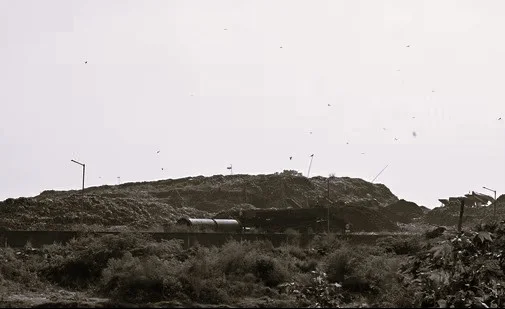


Chandigarh’s Dadumajra landfill has once again come under scrutiny, with the Chandigarh Pollution Control Committee (CPCC) reporting serious lapses in solid waste and leachate management to the National Green Tribunal (NGT). The committee’s detailed status report, submitted in compliance with NGT directions, pointed to mismanagement of waste, aggravated by above-average rainfall during this year’s monsoon. The excess rainwater, it noted, had mixed with piled-up garbage, forming toxic leachate that risked polluting nearby water bodies.
During a recent inspection, CPCC officials observed multiple violations in handling the leachate — a harmful liquid formed when rainwater seeps through decomposing waste and carries dissolved pollutants. The committee reported that two leachate treatment plants (LTPs) are currently functional at the site: a 100 kilolitres daily (KLD) unit at the wet waste compost plant and another with a 26 KLD capacity at the newer landfill section. Although the treated water quality has shown improvement, officials maintained that the pollutant levels remain “on the higher side.”
To supplement local treatment, the Municipal Corporation (MC) has been coordinating with the Common Effluent Treatment Plant (CETP) in Baddi, Himachal Pradesh, for additional processing. The CPCC issued a formal notice to the MC on July 22, 2025, flagging non-compliance. In its response on August 25, the civic body outlined corrective measures undertaken, including immediate repairs and containment steps.
Following the exchange, CPCC directed the MC to ensure there was no spillage or stagnation of leachate and to restore damaged sections of the boundary wall to prevent seepage into the nearby Patiala Ki Rao choe. The committee’s latest findings indicate progress — the boundary wall has been repaired, new channels constructed to guide leachate into treatment facilities, and improved flooring laid near the wet waste plant to prevent pooling.
“Recent water samples from both upstream and downstream points of Patiala Ki Rao revealed no evidence of leachate contamination,” the report stated, adding that water quality remained consistent before and after passing through Chandigarh limits.
Meanwhile, in its separate affidavit before the NGT, the Municipal Corporation detailed preventive measures taken after incidents of overflowing leachate, contaminated runoff, and a landfill fire reported on May 31, 2025. The fire, attributed to spontaneous methane ignition during waste decomposition, was brought under control swiftly.
“The situation has been remedied since July, and additional precautions are now in place,” MC stated, citing use of tractor-mounted suction tankers to collect rainwater-leachate mixtures and diversion of excess runoff to the nearest sewage treatment plant (STP). Contractors have also been instructed to prevent any leakage into Patiala Ki Rao.
The Dadumajra landfill spans nearly 45 acres, of which 20 acres have been bio-remediated and closed to new dumping. A new 16.72-acre zone is currently used for inert waste, while the remaining land hosts processing units, including a 300 tonnes per day (TPD) wet waste plant and a 100 TPD mixed waste facility commissioned in December 2024. Bio-mining of legacy waste, delayed from its initial May 2025 deadline, is now targeted for completion by November 2025, the MC informed the tribunal.