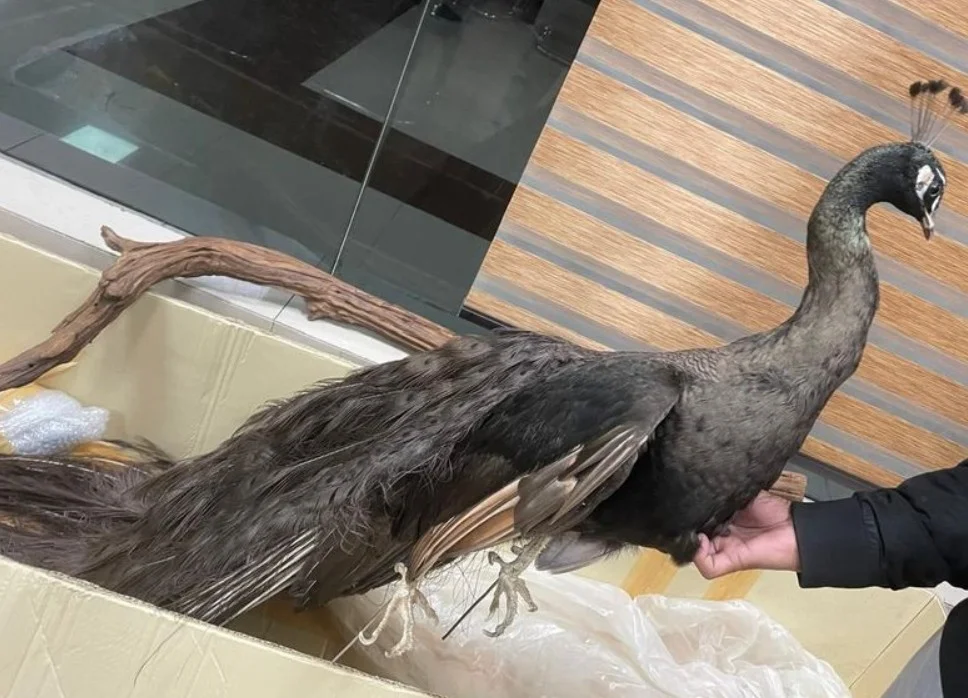


Amritsar, Jan 24: The Customs Department at Sri Guru Ram Dass Jee International Airport has apprehended an individual following the seizure of illegally imported taxidermy trophies of a peacock and a walrus. The incident has prompted wildlife enforcement agencies to intensify their focus on the illicit global trade of exotic animal artifacts arriving in the country.
The contraband was allegedly smuggled from Bangkok and discovered during a routine inspection. Officials identified the suspect as Mohammad Akbar Ahmed, who was arrested in connection with the shipment. A team from the Wildlife Crime Control Bureau (WCCB) conducted a preliminary examination and confirmed that both the peacock and walrus trophies were genuine specimens.
This marks the first reported case of its kind in the state, involving species that are neither native to India nor legally permitted for private ownership. Under the Wild Life (Transactions and Taxidermy) Rules, 2024, such imports are restricted to educational or scientific purposes and require strict permits under the Convention on International Trade in Endangered Species of Wild Fauna and Flora (CITES).
Wildlife biologist Sunal Singh Roamin noted that the global illegal wildlife trade is a massive enterprise, estimated to be worth over USD 200 billion annually. He mentioned that the trade ranks among the top five illegal activities globally, alongside the trafficking of weapons and drugs. Experts noted that while India has limited local expertise in taxidermy for exotic species, the demand from private collectors continues to drive these illegal activities.
The WCCB is currently investigating whether the seized items were meant for a specific local buyer or if Amritsar was being used as a transit point for a larger international supply chain. Amritsar District Forest Officer Rajesh Mahajan said that enforcement teams regularly monitor markets and herbal medicine shops for items banned under Schedule I of the Wildlife (Protection) Act, 1972.
“Our teams frequently conduct checks to curb the sale of wildlife-derived products,” Mahajan mentioned, adding that while some items found in local shops are fraudulent replicas, genuine contraband is occasionally recovered.
The recent airport seizure follows a significant enforcement operation last July, where the WCCB recovered protected items including monitor lizard organs, bear bile, and various types of coral from local markets.
“The investigation will now focus on tracing the international network involved in this transit,” a WCCB official directly said.