

Column By Senior Journalist, Afroz Ahmad
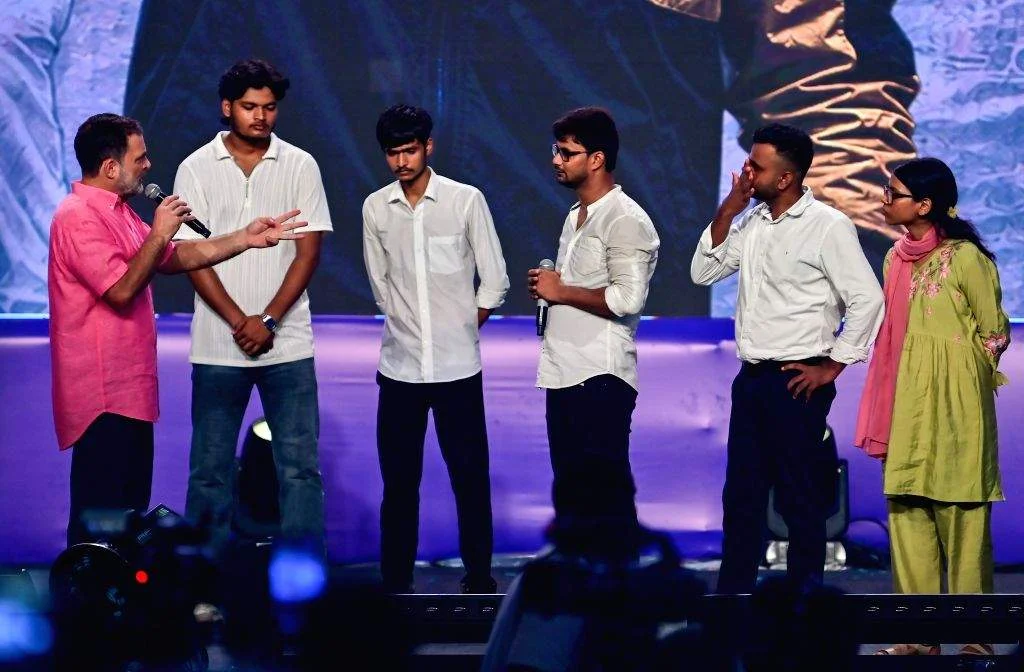
Prayagraj has held a historic place in Uttar Pradesh politics as a centre of ideological and political movements. Lakhs of students from across the country come to this city to prepare for competitive examinations, making it their workplace and centre of aspirations. This is why when the Leader of Opposition in Lok Sabha, Rahul Gandhi, held the Chhatron Ki Goonj interaction programme in Prayagraj, political circles viewed it as an attempt to assemble a show of strength against the state administration. The stated objective was to unite student concerns over issues such as paper leaks, unemployment, and recruitment delays to address the state government’s policies. However, the event did not yield those intended political results.
Despite political claims, large posters, and extensive promotional tools, the event failed to generate the anticipated momentum. Owing to an absent grassroots strategy, unclear direction, and missing operational leadership, the programme remained a basic formal interaction rather than a sustained challenge to the political structure of the state administration. Event turnout was estimated at around five thousand students. While organisers may attribute performance to logistical shortcomings, observers note that a substantial section of the youth in Uttar Pradesh views the administration’s efforts, particularly around public safety measures for women, as a positive factor expanding educational and employment opportunities. Consequently, the narrative presented during the visit lacked a strong foundational response from the audience.
The inability to mobilize students in a major academic hub like Prayagraj points to a need for internal political review. During the event, the address relied heavily on broad global concepts like data, artificial intelligence, corporate trends, and the international economy. The level of dialogue between national leadership and the attendees remained routine. The address lacked specific administrative data, nor did it put forward a distinct policy roadmap or actionable blueprint for the youth. Students attending the venue were expecting a structured platform detailing alternative policy approaches, leading to a sense of missed opportunity among participants.
In Uttar Pradesh, the administrative approach under the present state government has maintained a focus on strict law enforcement and rapid decision-making. Recent measures and updated legal provisions designed to prevent exam irregularities have largely countered opposition criticism on recruitment processes. Furthermore, established party networks and affiliated youth groups in Prayagraj maintain active, booth-level student structures. In contrast, opposition political units and youth organisations like the NSUI currently lack the deep cadre presence required to sustain continuous engagement across universities and coaching institutes. Without a functional base, political visits alone cannot build sustained civic movements.
Political dynamics in Uttar Pradesh do not shift solely on account of single-day public appearances or short-term media drives. To present a sustained political alternative, opposition groups must offer a coherent vision for the future. A key challenge remains the absence of a distinct policy framework for youth development. The Prayagraj visit concluded as an isolated event, with no announcement of a permanent student action committee or long-term operational strategy. As a result, the initiative lost traction quickly at the local level without exerting administrative pressure.
The Chhatron Ki Goonj drive in Prayagraj indicates that high-profile leadership visits and short-term media visibility are insufficient to build momentum in a complex state like Uttar Pradesh. Establishing political traction requires presenting concrete policy initiatives that offer clear improvements over existing governance models. Rather than focusing resources primarily on high-profile visits, opposition parties would benefit from establishing clear, working models of youth development in states where they hold governing responsibilities to demonstrate viable alternatives.