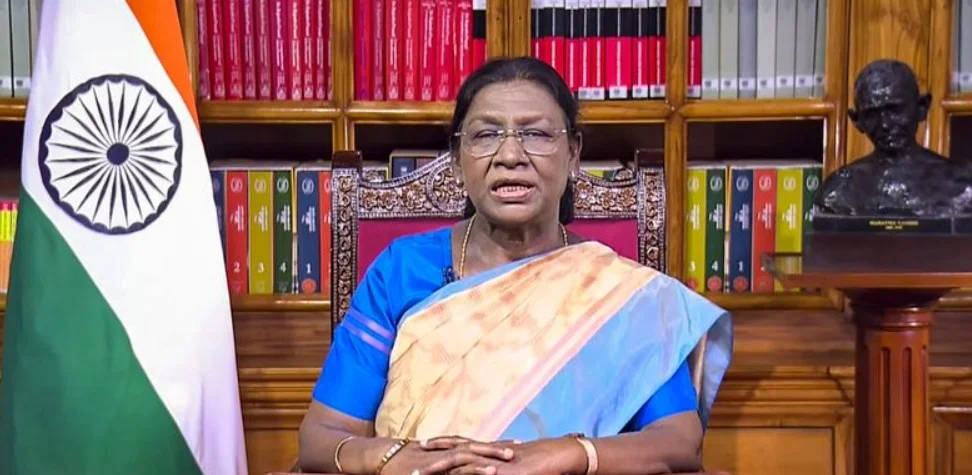


New Delhi, August 14: President Droupadi Murmu has praised the courage and professionalism of the Indian Armed Forces, saying Operation Sindoor demonstrated India’s ability to respond to terrorism with precision and determination and delivered a strong message that terrorists and those supporting them would be held accountable regardless of where they seek refuge.
Addressing the nation on the eve of the 80th Independence Day, President Murmu recalled the first anniversary of Operation Sindoor and paid tribute to the Armed Forces for their role in confronting terrorist threats.
The President said the operation reflected the country’s growing military capability and its resolve to deal firmly with terrorism.
Recalling important milestones, she said that the nation had observed Kargil Vijay Diwas on July 26 and had earlier marked one year since the launch of Operation Sindoor on May 7.
“We remembered the unmatched valour of our Armed Forces,” the President said while highlighting the sacrifices and dedication of the country’s soldiers.
She stressed that Operation Sindoor conveyed an unequivocal message to terrorist organisations and those providing them support.
According to President Murmu, terrorists and their backers cannot assume that they will remain beyond the reach of Indian security forces simply by operating from locations outside the country. The operation, she said, demonstrated India’s determination and capability to respond decisively to threats against its people and national security.
Operation Sindoor was launched in May 2025 following the Pahalgam terror attack, in which 26 people were killed. India subsequently carried out strikes against terrorist infrastructure in Pakistan and Pakistan-occupied Jammu and Kashmir, targeting facilities associated with terrorist organisations.
Indus Waters Treaty Suspension in National Interest
President Murmu also referred to India’s decision to suspend the Indus Waters Treaty, describing it as an important decision taken in the national interest, particularly with regard to the concerns and interests of farmers.
She said the decision formed part of India’s wider response to emerging security challenges while emphasising that protection of national interests remains a key priority.
Progress Against Naxalism Highlighted
On the internal security front, the President described the country’s progress towards becoming Naxal-free as a significant achievement following decades of challenges.
She said several areas that had once been affected by violence and Naxalism were now witnessing development, renewed confidence and greater community participation.
According to her, the transformation in such regions reflected the combined impact of improved security, development initiatives and efforts to bring local communities into the mainstream of national progress.
Government Taking Steps Against Paper Leaks
President Murmu also addressed concerns surrounding competitive and public examinations, particularly among students.
She said comprehensive reforms were being undertaken to strengthen the examination system, prevent paper leaks and curb the use of unfair means.
The President stressed the need for examinations to remain transparent, secure and credible, describing students and young people as key builders of India’s future.
She also highlighted the growing entrepreneurial spirit among the country’s youth, noting that an increasing number of young Indians were choosing entrepreneurship, self-employment and job creation.
The President underlined the contribution of India’s expanding start-up ecosystem towards economic growth, innovation and employment generation.
Sports and Youth Development Remain Key Priorities
President Murmu said the physical and mental well-being of young people would play an important role in shaping India’s future.
She highlighted the contribution of sports to youth development and nation-building through initiatives such as the Khelo India programme.
She said participation in sports not only promotes physical fitness but also helps develop discipline, confidence, teamwork and a spirit of achievement among young Indians.
Digital Growth, Infrastructure and Economy
The President also highlighted India’s progress in digital infrastructure, renewable energy, highways, railways, waterways and aviation.
She said the expansion of infrastructure and the country’s economic resilience were opening new opportunities for businesses and creating employment.
According to her, these developments were also contributing to greater investor confidence and strengthening the foundation for sustained economic growth.
Peace and Cooperation Central to Foreign Policy
President Murmu reiterated India’s commitment to peace, dialogue and international cooperation, while invoking the principle of Vasudhaiva Kutumbakam.
She said India remained committed to a rules-based international order and continued to advocate cooperation and peaceful engagement while safeguarding its national interests.
Vision of Viksit Bharat by 2047
The President also highlighted welfare measures aimed at improving the quality of life of senior citizens and other sections of society.
She said India was steadily moving towards the goal of becoming a Viksit Bharat by 2047, with economic expansion, technological advancement, stronger infrastructure and inclusive development playing central roles.
President Murmu said the country’s journey towards 2047 would be driven by the energy of its youth, greater participation of women, technological progress and opportunities for all sections of society.
She expressed confidence that with collective effort, determination and inclusive growth, India would continue to strengthen its position on the global stage while building a more prosperous and developed nation.