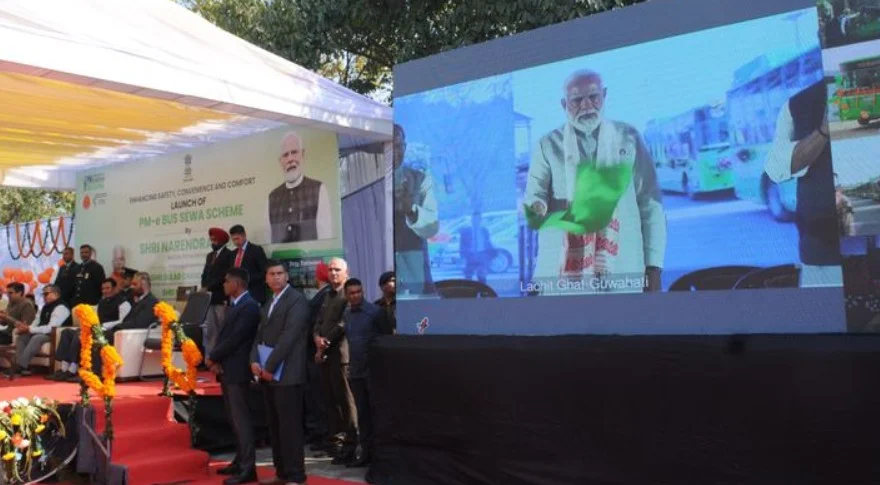


Chandigarh, Feb 14: Prime Minister Narendra Modi on Saturday virtually launched 25 new electric buses for Chandigarh as part of the PM e-Bus Sewa Scheme. Flagging off the vehicles from Guwahati during an infrastructure inauguration event, the Prime Minister stated that the initiative aligns with the Union Government’s vision for sustainable urban mobility.
The launch in Chandigarh was attended by Punjab Governor and UT Administrator Gulab Chand Kataria, Mayor Saurabh Joshi, and Chief Secretary H Rajesh Prasad. Following the addition of these 25 vehicles, the city’s operational electric bus fleet has grown to 105.
“International academic partnerships strengthen educational standards and widen global exposure for students,” Vice Chancellor Renu Vig mentioned in a separate recent development, while regarding the bus launch, officials affirmed that the Ministry of Housing and Urban Affairs has sanctioned a total of 428 buses for the city.
The newly inducted 12-meter air-conditioned buses feature a range of 224 km on a single charge and are designed for accessibility with a 400 mm low-floor height. To assist commuters with disabilities, the vehicles are equipped with power-operated ramps and an electronic kneeling mechanism.
“The induction of electric buses will help provide a pollution-free environment and significantly improve the quality of public transport,” senior BJP leader Sanjay Tandon declared at the event. He maintained that the move is an invaluable gift toward transforming Chandigarh into a modern, eco-friendly city.
The Chandigarh Administration has asserted its goal to phase out all diesel-operated buses in the tri-city area by the end of the 2027-28 financial year. An official statement noted that an additional 75 buses from the first lot are expected to be delivered by May 2026, bringing the total count to 180 in the coming months.
To ensure safety, each bus is fitted with five CCTV cameras, panic buttons integrated with the State Transport Authority’s control center, and a GPS-based tracking system. The fare revenue will be collected by the Transport Department, while the operator remains responsible for the upkeep and operation of the fleet.