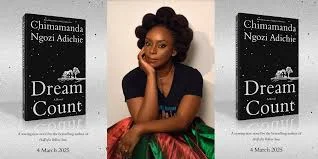


Chandigarh, Dec 5: In Dream Count, Nigerian novelist Chimamanda Ngozi Adichie turns her familiar terrain of migration, womanhood, and private longing into a four-voiced narrative that feels both intimate and panoramic. The novel follows four women whose lives intersect through blood, friendship, labour, and the fragile threads of diaspora survival.
Chiamaka, a Nigerian travel writer, becomes stranded in America when the pandemic shuts down borders. Her career, built on constant movement, collapses into a claustrophobic stillness that forces her to confront the emotional distances she has long avoided.
Her friend Zikora, a sharp and successful lawyer, appears on the surface to have mastered the immigrant trajectory—until the isolation of the pandemic begins to crack the armour she has spent years forging. In her chapters, ambition becomes both shield and prison.
Omelogor, Chiamaka’s cousin, arrives from Nigeria to study after a stint in finance. Her story captures the ache of reinvention—how leaving home can feel like both an ascent and an unraveling. She grapples with loneliness, racial tension, and the weight of expectations she never asked to carry.
Lastly, there is Kadiatou, Chiamaka’s housekeeper. Her voice—quiet but unignorable—becomes the emotional anchor of the book. Through her, the novel threads the story of immigrant domestic labour, the silent intimacies of caregiving, and the dreams that survive even when dignity is constantly negotiated.
Across these four women, Dream Count maps the private fractures the pandemic made visible: the way borders turned into walls, the way freedom shrank, and the way the inner world began to speak louder than ever before. The novel unfolds in rotating chapters, each voice offering a different angle on loss, longing, womanhood, and the messy, exhausting beauty of survival.
Dream Count reads like an emotional ledger of a disrupted world. What makes the novel powerful is not simply its pandemic setting, but how it uses that moment to distil the quieter truths of women’s lives—ambition, sacrifice, anxiety, love, and the invisible labour that keeps relationships alive.
Adichie’s signature strength—her ability to capture moral nuance in everyday moments—is on full display. The women in this book do not represent archetypes; they occupy contradictions. Chiamaka longs for home yet fears returning. Zikora is brilliant but brittle, outwardly assured while privately spiralling. Omelogor is hopeful but exhausted, the kind of immigrant who must constantly re-prove her worth. And Kadiatou’s chapters carry the novel’s deepest tenderness, revealing how power operates not just through money but through silence, gratitude, guilt, and everyday dependence.
The structure—four interlocking personal narratives—gives the novel the rhythm of confession. Some chapters burn with anger; others feel like whispered diary entries. The pandemic setting never overwhelms; instead, it becomes a soft frame for exploring identity and intimacy in crisis.
Where the novel truly shines is its emotional honesty. The writing is uncluttered, direct, and piercing. The friendships are messy, the family dynamics imperfect, and the loneliness palpable. Yet the novel resists despair; it insists on the small stubbornness of hope, the dream-work of counting what still matters.
Dream Count is a resonant, beautifully constructed novel—a story of four women whose dreams collide, expand, and survive even in a world that insists on shrinking them. It is a rich, humane, multilayered work that lingers long after the last page.