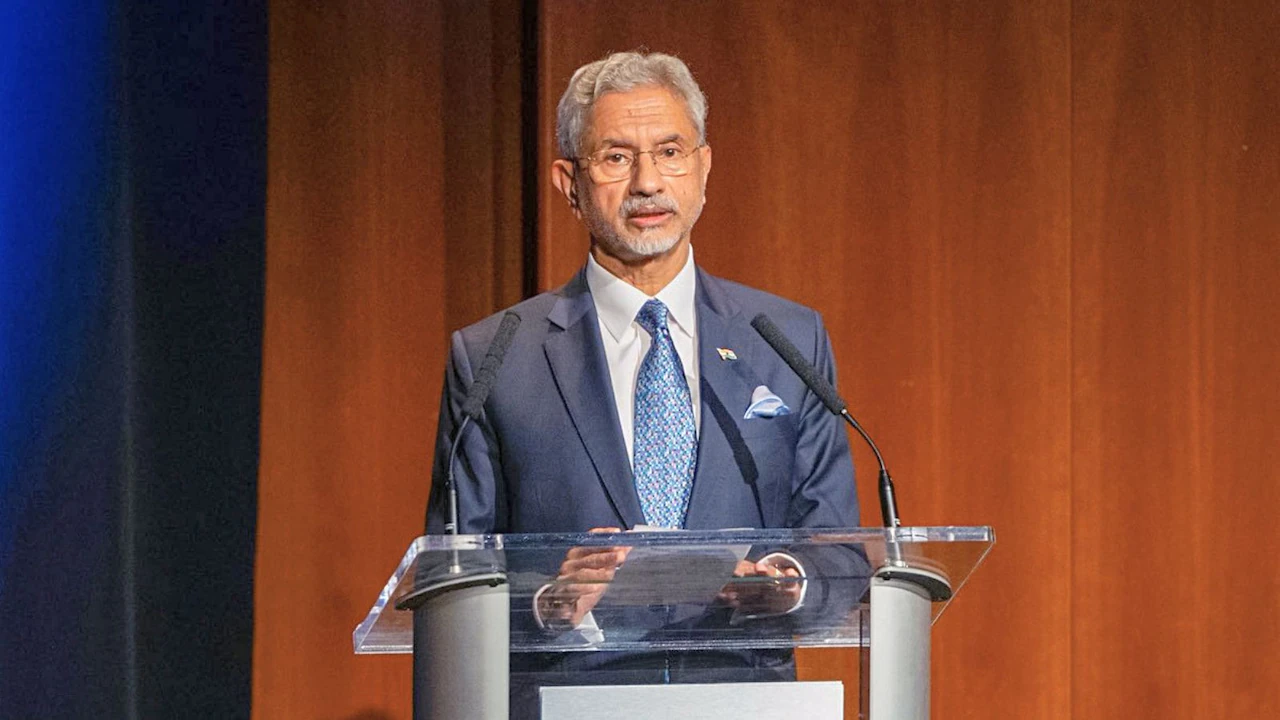


New Delhi, November 15: External Affairs Minister S. Jaishankar has said that India’s border with China has become increasingly active and requires a significantly greater and sustained deployment of troops, highlighting the country’s growing focus on strengthening strategic infrastructure and military preparedness along the Line of Actual Control (LAC).
Speaking at an interactive session in New Delhi, Jaishankar said India’s ability to maintain and deploy troops along the China frontier had witnessed a considerable improvement over the past decade, supported by major investments in roads, tunnels, bridges and airfields.
Referring to the changing situation along the border, the External Affairs Minister observed that infrastructure development has gained considerable momentum, with new strategic projects being completed at increasingly frequent intervals.
“Today, the border with China has become more alive in a way. It has required a much greater commitment of troops on a sustained basis,” Jaishankar said.
He explained that the infrastructure already developed by India had enabled the armed forces to maintain larger troop deployments in forward areas, while ongoing construction and connectivity projects would help sustain these capabilities in the coming years.
Jaishankar also highlighted the improvement in India’s military preparedness following the deadly confrontation in Galwan Valley of eastern Ladakh in June 2020, when tensions between Indian and Chinese troops escalated into a violent clash.
The minister pointed out that border infrastructure had remained neglected for several decades and that a significant policy push, allocation of resources and focused attention had been introduced during the past ten years.
He said the transformation could be assessed by examining the expansion of road networks, construction of tunnels, improved positioning and development of supporting infrastructure along sensitive border areas.
According to Jaishankar, the country’s ability to mobilise and sustain troops along the China border has improved markedly, strengthening India’s operational preparedness in strategically important frontier regions.
The remarks come amid continuing diplomatic efforts by India and China to stabilise and normalise bilateral relations following the prolonged military standoff in eastern Ladakh.
Relations between the two countries witnessed severe strain after the 2020 Galwan Valley confrontation. However, diplomatic engagement gathered momentum following the meeting between Prime Minister Narendra Modi and Chinese President Xi Jinping in Kazan, Russia, in October 2024.
The discussions between the two leaders covered several important issues, including bilateral trade, economic cooperation, counter-terrorism and broader regional and international developments.
Jaishankar also addressed the economic imbalance between India and China, recalling that the two countries had economies of comparable size around the time of former Prime Minister Rajiv Gandhi’s visit to China in 1988.
He observed that China made substantial investments in modernisation and industrialisation during the 1980s, while India missed important opportunities to accelerate its industrial growth.
The minister said India subsequently undertook economic reforms during the 1990s but did not maintain the same pace of sector-wise transformation and industrial development.
Emphasising the need to strengthen India’s economic and technological capabilities, Jaishankar said the country must identify areas where it could build competitive advantages rather than attempting to match China in every sector.
He stressed that manufacturing, industrial development and stronger domestic capabilities would remain important to addressing the economic and strategic challenges posed by the growing asymmetry between the two countries.
The External Affairs Minister’s remarks underline India’s continued emphasis on strengthening border infrastructure, improving military logistics and ensuring long-term operational preparedness along its sensitive northern frontier.