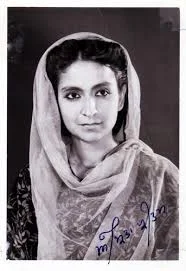


Chandigarh, August 24: Amrita Pritam (1919–2005) remains one of the most iconic voices of Punjabi and Hindi literature, remembered not only for her poetry but also for the intensity of her personal life.
From every message, your name emerges,
And even in silence,
It is only your voice I hear.
Author of more than 100 books of poetry, fiction and essays, she gave voice to women’s desire, loss and rebellion at a time when writing about such themes was seen as transgressive. Yet beyond her literary genius, Amrita’s name is often entwined with a remarkable triangular love story — between herself, her husband Pritam Singh, and the artist Imroz, with Sahir Ludhianvi’s shadow ever lingering.
Amrita married editor Pritam Singh at the age of 16, but her marriage was marked by differences in temperament and lack of companionship. The turning point came when she encountered the Urdu poet Sahir Ludhianvi.
There was something between you and me,
Something that neither began, nor ever ended.
Their bond was one of profound creative connection, and though never formally acknowledged as a relationship, Amrita herself wrote candidly about her infatuation with Sahir.
Whenever I tried to write the truth,
It formed only one line —
I am waiting for you.
In her autobiography Raseedi Ticket (The Revenue Stamp), she recalled how Sahir’s presence haunted her. She described how she would smoke the cigarette stubs he left behind, feeling a strange intimacy in inhaling the remnants of his breath. That yearning remained unfulfilled, but it inspired some of her most poignant verses. Their relationship existed in fragments — letters, silences, and longing more than togetherness.
One of her most quoted lines, addressed almost as if to Sahir, captures that unresolved intensity:
“Main tenu phir milangi…
Kithe? Kis tarah? Main nahi jandi
Par main tenu phir milangi.”
(“I will meet you again…
Where? How? I do not know.
But I will meet you again.”)
I will meet you again,
Where? How? I do not know.
Perhaps as a figure in your thoughts,
Or a smile on the silence of your lips.
If Sahir was the muse of longing, Imroz — painter and lifelong companion — was the embodiment of devotion. Amrita met Imroz after she had already separated from her husband. Their relationship, unconventional by the standards of the time, spanned over four decades. They never married, yet lived together in Delhi in what was a quiet testament to companionship beyond societal labels.
Imroz designed many of Amrita’s book covers, while she immortalized him in her poems. Unlike the aching absence that defined her bond with Sahir, her life with Imroz reflected steadiness, shared daily rituals, and an intimacy that nourished both art and love. Even after her death in 2005, Imroz continued to speak of her as though she were still present, saying, “Amrita never left. She lives with me in every corner of this house, in every word she wrote.”
Amrita’s love stories were not just private matters — they were woven into her creative expression. Her poems often blurred the boundaries between the personal and the political. She became the first woman to win the Sahitya Akademi Award in 1956 for her long Punjabi poem Sunehadey, and her voice during the Partition tragedy, particularly in Aj Aakhaan Waris Shah Nu, cemented her as the conscience of Punjab’s pain.
In that famous elegy, she invoked Sufi poet Waris Shah to rise from his grave and witness the bloodshed and despair of women during Partition. Love, for Amrita, was always entangled with suffering, history, and resilience.
Today I call upon Waris Shah,
Rise from your grave and speak,
And open a new page
In the book of love today.
Her triangular love story — Sahir’s absence, Imroz’s presence, and the hollow marriage that framed it — reflected the complexities of desire in a society where women were rarely allowed to claim agency. She did so unapologetically, making her one of the first Indian women writers to speak openly about love outside marriage.
What makes Amrita Pritam endure is not just the drama of her personal life, but how she translated it into poetry that still resonates with readers today. Her words are taught in schools, quoted in films, and recited at mushairas. She gave voice to women’s suppressed longings in a manner that was lyrical yet fierce.
When she wrote, “Main tenu phir milangi,” she was not only addressing a lover. She was writing about the eternal return of love itself, the way passion transcends death, time, and distance. In many ways, that line has become her epitaph — a promise that her voice will meet us again each time her poems are read.
Amrita’s life was a paradox of unfulfilled love and fulfilled artistry. Between Sahir’s silence, Imroz’s devotion, and her own restless heart, she carved a space in literature where love was not neat or moral, but raw, disruptive, and deeply human. That is why she remains, even today, the eternal poet of longing — who promised to meet us again, and through her words, always does.