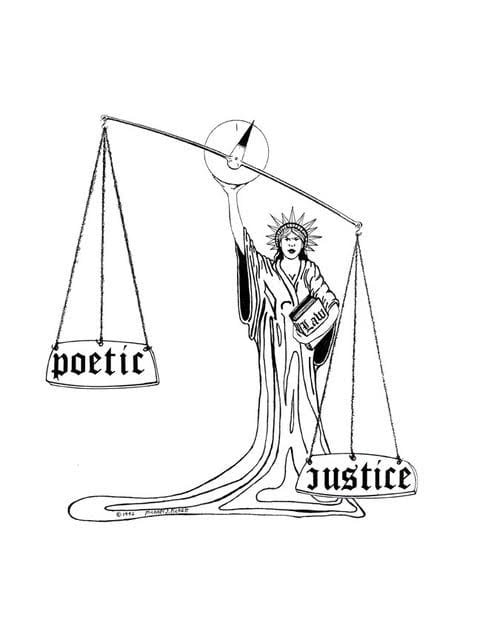


Chandigarh, Oct 11: In the quiet corners of human imagination, the idea of poetic justice has always held a unique allure. It is the notion that the universe has a way of balancing the scales, ensuring that wrongdoers face consequences that mirror their misdeeds and that the virtuous are ultimately rewarded. Stories, from ancient epics to contemporary cinema, thrive on this principle, giving audiences a sense of moral satisfaction. Yet, in real life, poetic justice remains elusive, incomplete, and often frustratingly absent. And still, in the face of persistent injustice, people continue to hope.
At its core, poetic justice is deeply rooted in the human desire for fairness. We instinctively look for patterns of cause and effect in moral terms, craving an order where cruelty is met with consequence and kindness is acknowledged. Literature and folklore across cultures abound with tales that embody this principle. Consider Shakespeare’s plays: villains often meet fates that reflect their own treachery, and heroes are rewarded for their virtue. Similarly, classic folktales and modern films alike rely on the neat closure of poetic justice to satisfy our ethical appetites. It is as if the human mind demands this symmetry to believe in a just world.
Yet life rarely conforms to the neatness of fiction. The world is messy, and human actions do not always produce consequences proportional to their intent or morality. Those who commit grave injustices may go unpunished, while those who endure hardships may find no reward or recognition for their struggles. Wars, corruption, inequality, and personal betrayals often leave victims without retribution or closure. The scales of justice, societal or cosmic, do not always balance. In this sense, poetic justice is incomplete—a concept that exists more robustly in the imagination than in reality.
Philosophers and thinkers have long grappled with this tension. The ancient Greeks, for instance, spoke of Nemesis, the goddess of retribution who would ensure that hubris and moral failings did not go unchecked. But even in Greek tragedies, the results are bittersweet, reminding audiences that justice is seldom absolute. Modern psychology offers a parallel: humans have a cognitive bias toward believing in a just world—a mental shortcut that allows us to make sense of suffering and misfortune. This belief sustains hope, but it can also lead to disillusionment when reality fails to deliver.
Despite this incompleteness, hope persists. There is a deeply human reason for this: hope for poetic justice serves as a moral compass. Believing that wrongs will eventually meet their consequence encourages people to uphold ethical standards, to act with integrity even when immediate rewards are uncertain. Hope acts as a social glue, fostering trust and patience in communities. In a world where injustice is frequent, the aspiration for poetic justice becomes a silent, collective act of resilience. It is the quiet belief that, even if the world does not deliver perfect balance today, our actions and intentions still matter.
Stories of small, everyday poetic justice continue to inspire. Viral news clips of bullies facing public humiliation, con artists being caught, or everyday acts of kindness being acknowledged provide fleeting but powerful affirmations. These instances, though minor and rare, reaffirm our faith that there is a moral rhythm to life, however irregular it may be. And for the broader society, these small victories become symbolic—they remind us that justice, while often delayed or imperfect, is not entirely absent.
Yet the hope for poetic justice also carries a bittersweet undertone. It is, in many ways, an admission of human vulnerability: a recognition that the world is fundamentally unfair, and that we cannot control every outcome. This duality—of hope and frustration, belief and skepticism—defines our relationship with justice. People continue to cling to the idea because it provides comfort, a narrative structure in an otherwise chaotic world. It allows us to imagine that even in the harshest circumstances, there exists a possibility of moral equilibrium.
Artists, writers, and filmmakers have long exploited this tension. Tragedies often deny poetic justice to their characters, yet audiences are compelled to reflect, empathize, and imagine alternative outcomes. Comedies and dramas frequently reward virtue and punish vice, not merely for narrative satisfaction but as an expression of collective longing. In this sense, poetic justice is less a guarantee and more a lens through which humanity examines its own values, aspirations, and disappointments.
Moreover, the hope for poetic justice can be transformative on an individual level. It encourages reflection, fosters moral imagination, and inspires action against injustice. While the universe may not always intervene to right wrongs, individuals and societies often do. Advocacy, legal recourse, social movements, and everyday acts of courage are all ways humans attempt to fulfill the promise of poetic justice themselves. In this way, even if the cosmic scales remain imbalanced, human agency becomes a source of partial fulfillment.
Ultimately, poetic justice is incomplete because reality is complex, nuanced, and often indifferent. Its incompleteness, however, does not diminish its value. On the contrary, the very imperfection of poetic justice makes the hope for it more poignant, more necessary. It is a reminder that life is not a scripted narrative and that moral balance requires effort, patience, and resilience. In our yearning for justice, we find the courage to persist, the empathy to care, and the moral imagination to dream of a world where virtue is recognized and vice is confronted.
In the end, perhaps poetic justice is never truly “complete” because human life itself is incomplete—shaped by ambiguity, contradictions, and unexpected turns. Yet the hope that it can exist, even fleetingly, sustains us. It is a quiet, enduring faith that, no matter how elusive, the universe—and we ourselves—can still reflect the ethical symmetry we crave. For in that hope lies a deeper truth: that even when justice is incomplete, our desire for it defines the very humanity we seek to honor.