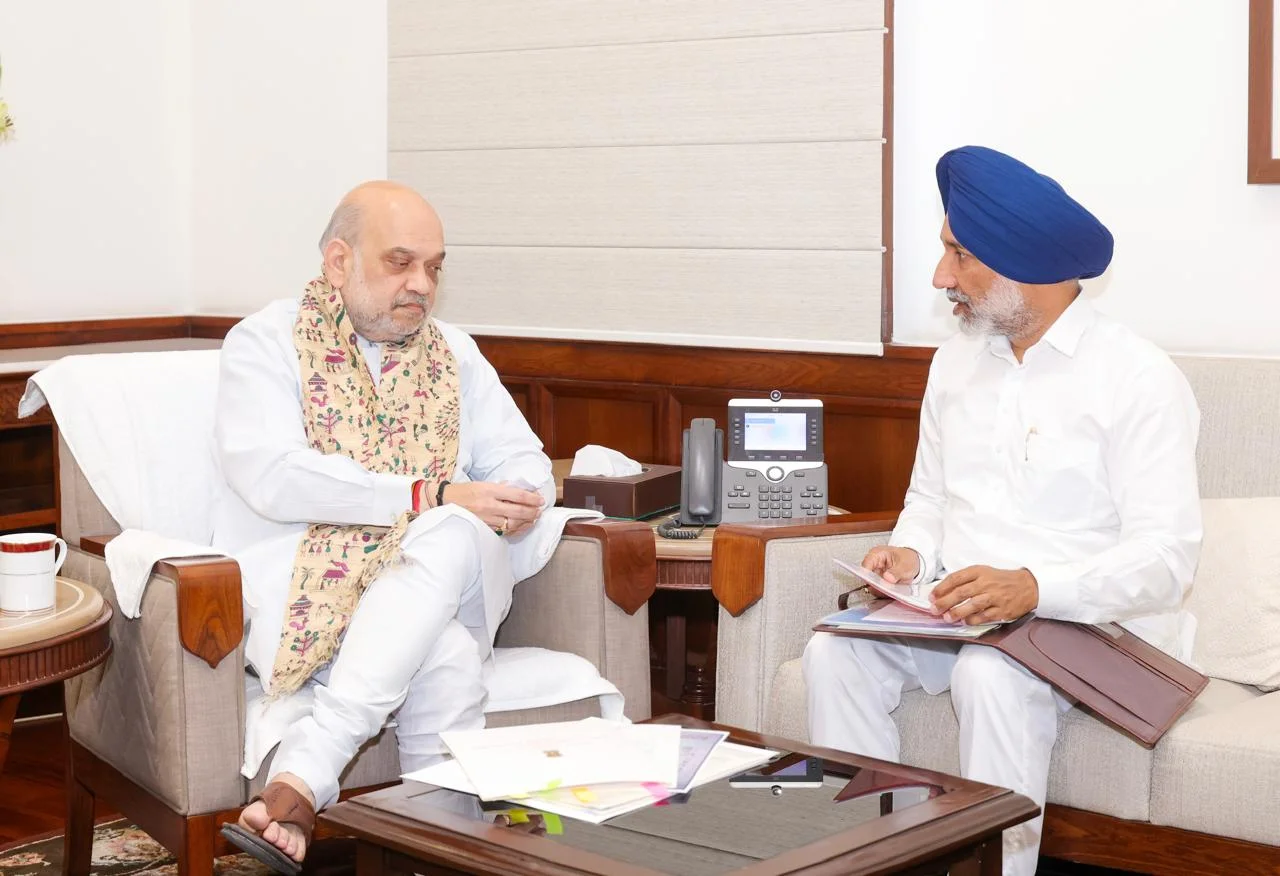


New Delhi, March 26: Rajya Sabha MP Satnam Singh Sandhu met Union Home Minister Amit Shah and submitted a 17-point report outlining a roadmap to address key challenges facing Punjab, including agriculture, employment, law and order, and recurring floods.
During the meeting, Sandhu discussed the state’s current situation in detail and presented recommendations prepared in consultation with former officials and domain experts. The report covers sectors such as industry, education, health care, water management, pollution and drug abuse.
Sandhu also shared a separate note focused on strengthening Punjab’s cooperative sector, calling for structural reforms and institutional support. “There is a need to establish a regional centre of the Central Cooperative University in Punjab and empower cooperative societies for new initiatives in food processing,” he said, adding that such steps could help revive stagnation in agriculture.
He further raised concerns about delays in the computerization of cooperative institutions in the state, stating that modernization is essential for improving efficiency and transparency.
Flood management featured prominently in the discussion, with Sandhu submitting a data-backed proposal seeking a long-term solution. “A comprehensive plan must be prepared to address the recurring floods in Punjab,” he said.
Referring to recent political developments, Sandhu told Shah that the party’s outreach in the state has gained traction. “After the Moga rally, there has been great enthusiasm among BJP workers, and public inclination towards the party is increasing,” he said.
The meeting comes days after Sandhu raised infrastructure concerns in Parliament, where he called for the introduction of a metro rail system in the Chandigarh Tricity region.
Speaking in the Rajya Sabha during the Budget Session, he said rapid population growth and rising vehicle density have made mass transit a necessity. “If this pace continues, the population will cross 40 lakh by 2041,” Sandhu said at the time.
He had warned that traffic speeds could drop sharply without intervention. “The average speed of vehicles, currently 25 to 30 kmph, may fall below 15 kmph if a modern system like metro is not developed,” he stated.
Sandhu also described the proposed metro network as a step toward improving regional connectivity and supporting long-term urban planning across Chandigarh, Mohali and Panchkula.