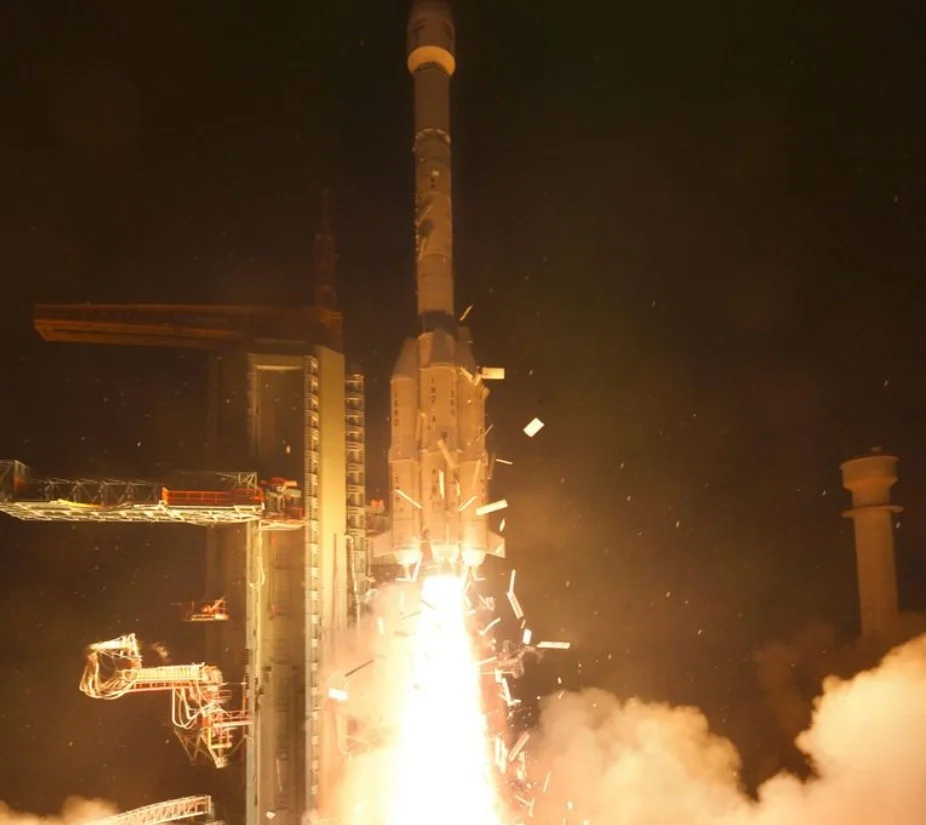


SRIHARIKOTA: In a major leap for the national space programme, the Indian Space Research Organisation script history on Friday by successfully launching the GSLV F17 rocket carrying the advanced earth observation satellite EOS-05 from the Satish Dhawan Space Centre. Lifting off at 2.55 AM from the second launch pad, the three-stage, 51.7-metre Geosynchronous Launch Vehicle placed the 2,367 kg payload into the intended sub-geosynchronous transfer orbit approximately 18 minutes after ascent. The pre-dawn operation, carried out following a smooth 27-hour countdown, brought immense cheer to dedicated space enthusiasts who gathered at the spaceport despite rain and odd hours.
The mission holds significant milestone value as EOS-05 represents the country’s first dedicated imaging satellite positioned in geo-orbit. Unlike conventional Earth observation satellites operating from low earth orbit, this payload will hover at an altitude of nearly 36,000 km, matching the rotational speed of Earth to provide continuous near real-time imagery. Dubbed as an eye in the sky by senior project scientists, the multi-band operational satellite is slated to strengthen national infrastructure across vital sectors such as disaster management, agriculture, and strategic monitoring.
Expressing satisfaction over the precise execution, ISRO Chairman V. Narayanan maintained that the vehicle injected the satellite into its exact target parameters. He affirmed that initial satellite data confirms perfect functioning of all onboard systems, including the successful deployment of solar panels. Department of Space Secretary V. Narayanan highlighted that payload capacity has steadily increased from 1,536 kg during the maiden GSLV D1 launch through continuous structural mass optimisation and propulsion improvements, making EOS-05 the heaviest satellite ever carried by a GSLV.
The breakthrough serves as a significant morale booster for the scientific community following earlier flight setbacks. Serving as a direct replacement for the unsuccessful GSLV F10 EOS-03 mission of 2021, which faced an upper-stage cryogenic anomaly, Friday’s success also ends an eight-month launch drought for the space agency. Project Director Imteyaz Ahamad and Mission Director Thomas Kurien asserted that orbit-raising maneuvers will take place over coming days to position the complex spacecraft into its final geostationary operational platform.