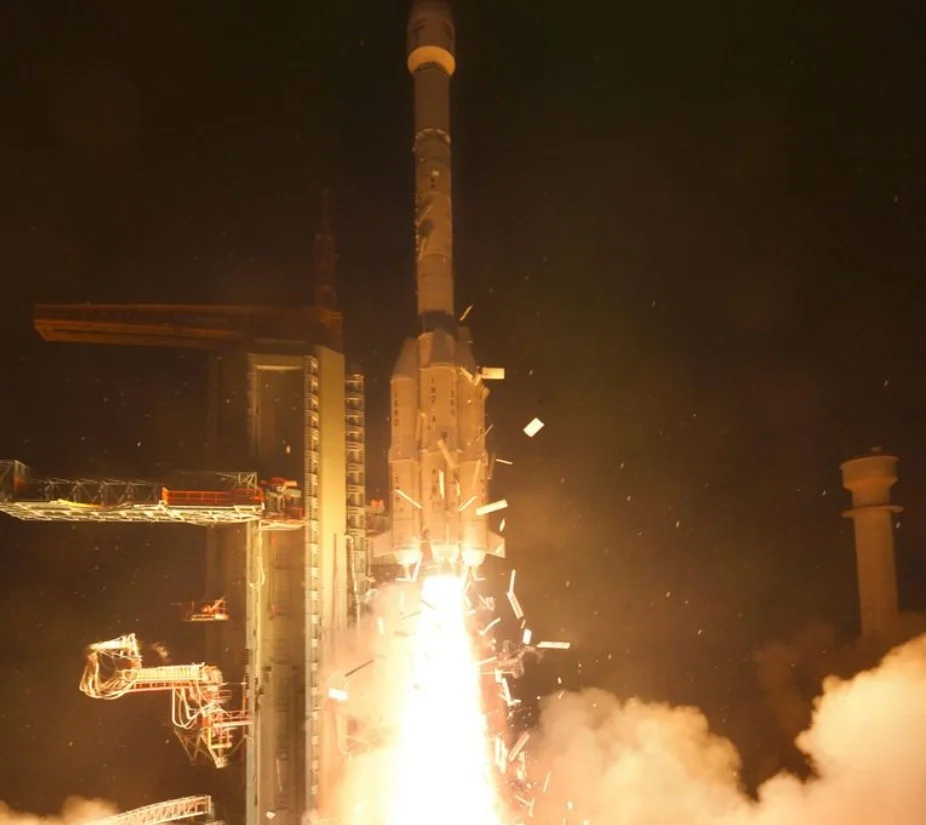


NEW DELHI, September 4: Prime Minister Narendra Modi on Friday congratulated the Indian Space Research Organisation (ISRO) for the successful launch of the GSLV-F17 carrying the Advanced Earth Observation Satellite-05 (EOS-05), describing the achievement as a significant boost to India’s expanding space programme.
The GSLV-F17 lifted off successfully from the Second Launch Pad at the Satish Dhawan Space Centre in Sriharikota at 2:55 am and subsequently placed the 2,367-kg EOS-05 into its targeted Sub-Geosynchronous Transfer Orbit (Sub-GTO).
The successful mission represents an important advancement in India’s Earth-observation capabilities and marks another step towards deploying increasingly sophisticated satellites through indigenous launch vehicles.
PM Modi Congratulates ISRO
Reacting to the mission, Prime Minister Modi praised ISRO scientists, engineers and all those associated with the launch, highlighting the country’s growing capabilities in space technology.
The Prime Minister also emphasised the increasing contribution of the private sector to India’s space ecosystem. He said the expanding partnership between ISRO, industry and other stakeholders was helping strengthen the country’s overall space capabilities and giving greater scale to its space activities.
EOS-05 to Provide Frequent Imaging From Geosynchronous Orbit
EOS-05 is an advanced Earth-observation spacecraft designed to provide repeated imaging of a large geographical region.
Once it reaches its designated final geosynchronous orbit, the satellite will become India’s first dedicated imaging Earth-observation satellite operating from a geosynchronous orbit, marking a notable development in the country’s space-based observation infrastructure.
The satellite is expected to support several civilian and national applications, including agriculture, forestry, water-resource management and disaster monitoring.
Its ability to repeatedly observe large areas could prove particularly useful during rapidly developing natural events such as cyclones, cloudbursts and thunderstorms, enabling quicker assessment and supporting disaster-management efforts.
GSLV-F17 Achieves Heaviest Payload Milestone
The mission also marked a significant achievement for the Geosynchronous Satellite Launch Vehicle.
The GSLV-F17 weighs approximately 420.5 tonnes and uses a three-stage configuration featuring an indigenous cryogenic upper stage. The successful deployment of the 2,367-kg EOS-05 represents the heaviest satellite payload placed into transfer orbit by an Indian GSLV launch vehicle so far.
The achievement reflects continued improvements in the vehicle’s propulsion, structural design and overall performance.
Satellite Successfully Injected Into Targeted Orbit
Following liftoff, the launch vehicle completed its planned flight sequence before separating EOS-05 approximately 18–19 minutes after launch.
The satellite was injected into the intended Sub-GTO and will subsequently carry out a series of orbit-raising manoeuvres to reach its operational geosynchronous position.
ISRO Chairman V Narayanan confirmed that the spacecraft was in good health after separation and that its major systems were functioning normally.
He also said the satellite’s solar panels had been deployed successfully, indicating that the spacecraft had entered the next phase of its mission.
ISRO Credits Scientists, Industry and Academia
Addressing officials and personnel at the mission control centre after the successful launch, Narayanan credited the achievement to the collective efforts of ISRO teams as well as partners from industry and academia.
The mission highlights the increasingly collaborative nature of India’s space programme, with government institutions, private companies and academic organisations playing growing roles in the development and execution of space missions.
According to ISRO officials, the GSLV-F17 mission is the 19th flight of the GSLV and the 107th launch from Sriharikota.
Major Enhancement to Earth-Observation Infrastructure
The deployment of EOS-05 is expected to significantly strengthen India’s ability to continuously monitor large geographical areas from space.
Unlike many conventional Earth-observation satellites operating in lower orbits, a geosynchronous imaging platform can repeatedly observe a broad region, making it valuable for applications requiring frequent updates.
The satellite’s data could therefore contribute to disaster preparedness, environmental monitoring, weather-related assessments and other strategic and developmental applications.
Boost for India’s Broader Space Ambitions
The successful mission comes at a time when India is rapidly expanding cooperation between its national space agency, private industry and academic institutions.
ISRO has outlined an ambitious mission schedule for the current financial year, with several major launches and programmes planned, including a navigation satellite mission and the first uncrewed mission associated with the Gaganyaan human-spaceflight programme.
The latest GSLV success is consequently being viewed as an important confidence boost for the agency as it prepares for these upcoming missions.
First Successful Orbital Mission of 2026
The GSLV-F17/EOS-05 mission also assumes added significance as ISRO’s first successful orbital launch of 2026.
The agency’s earlier PSLV-C62 mission in January encountered an anomaly during its third-stage flight. The successful performance of GSLV-F17 therefore provides renewed momentum to India’s launch programme.
With EOS-05 now on its journey towards operational geosynchronous orbit, the mission strengthens India’s independent capabilities in Earth observation, disaster management, environmental monitoring and space-based information gathering.
The successful launch is being hailed as another major milestone in India’s continuing efforts to build a stronger, more capable and increasingly self-reliant space ecosystem.