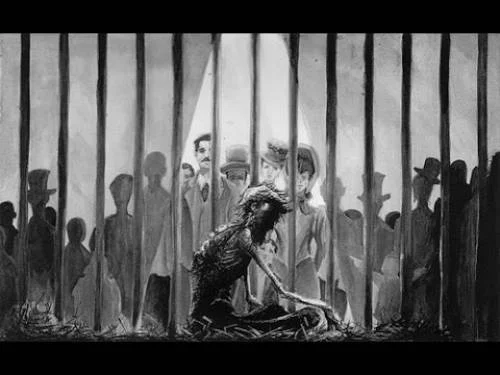


Chandigarh, Dec 25: “A Hunger Artist” is a short story that follows the life of a professional fasting performer who starves himself publicly as a form of art. Once admired and celebrated, the hunger artist performs inside a cage where spectators watch him endure long periods without food. His fasting is supervised to ensure honesty, but the public’s interest gradually fades.
The hunger artist is deeply committed to his craft. He is dissatisfied when his fasting is limited to forty days because he believes he could go much longer. However, public attention wanes after this point, and promoters end his performances to maintain audience interest.
As times change, fasting as entertainment becomes obsolete. The hunger artist is eventually forgotten and relegated to a circus, where he is placed near animal cages and largely ignored. There, he continues fasting without limit—no longer restrained by rules or time. Eventually, he is discovered near death. Before dying, he confesses that he never fasted out of discipline or virtue but because he could never find food he truly liked.
After his death, the circus replaces him with a lively panther—full of strength, appetite, and vitality—which immediately draws crowds, in stark contrast to the hunger artist’s silent suffering.
Kafka’s “A Hunger Artist” is a powerful allegory about alienation, misunderstood art, and the loneliness of extreme devotion. At its core, the story examines the gap between the artist’s inner truth and society’s shallow appreciation of art.
The hunger artist represents the artist who sacrifices everything for authenticity but remains unseen and misunderstood. His suffering is not staged or deceptive—yet people doubt him, grow bored, and eventually forget him. Kafka highlights how society consumes art only as long as it entertains, abandoning it once it becomes uncomfortable or demands patience.
The artist’s confession before death is one of the story’s most devastating moments. His fasting is revealed not as heroic self-denial but as a lack of desire—a metaphor for existential emptiness. This undermines any romantic notion of suffering and exposes the hunger artist as both tragic and deeply human.
The panther at the end serves as a sharp contrast: where the hunger artist lacks appetite and vitality, the panther embodies instinct, strength, and life. The crowd’s instant attraction to the animal underscores Kafka’s bleak view of public taste—society prefers visible vitality over quiet, invisible suffering.
Kafka’s prose is restrained, detached, and almost clinical, which intensifies the story’s emotional impact. The absence of dramatic language mirrors the hunger artist’s emotional isolation and the indifference of the world around him.
Overall, “A Hunger Artist” is a haunting meditation on artistic obsession, existential despair, and the cruel impermanence of recognition. It remains deeply relevant, especially in discussions about art, audience validation, and the cost of extreme authenticity.