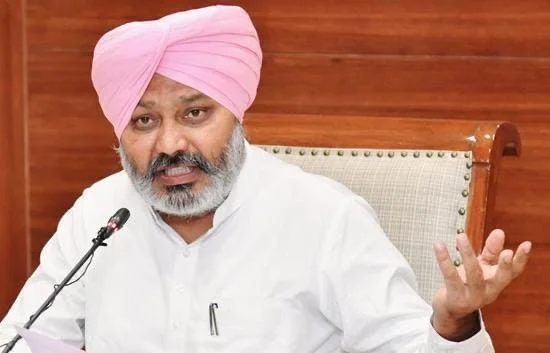


Chandigarh, May 23: The central government’s systematic withdrawal of ₹14.29 lakh crore from the Reserve Bank of India since 2014 undermines the core principles of cooperative federalism, Punjab Finance Minister Harpal Singh Cheema declared Saturday.
Speaking in Chandigarh, the finance minister asserted that the Union Government is increasingly treating the apex bank as a localized resource to artificially offset its fiscal deficit. Cheema noted that over half of the cumulative 12-year extraction occurred during the last three financial cycles alone, with the central bank transferring ₹2.10 lakh crore in 2023-24, ₹2.68 lakh crore in 2024-25, and a record-breaking ₹2.87 lakh crore during the current period.
The minister maintained that because the apex bank’s revenue is generated through economic activities spanning all regions, the resulting surplus should be deposited into the divisible pool of taxes to assist financially constrained states.
“The financial structure of the country is based on federalism,” Cheema stated in a video briefing. “Every Indian contributes to the economy and every state contributes to national growth and revenue generation. Then why are states denied their rightful share from such extraordinary gains?”
Cheema declared that while previous administrations only tapped into emergency reserve buffers during major global crises, regular extractions have now become a standard operational norm. He added that while individual states are managing identical global supply shocks, rising expenditure burdens, and severe inflation, the central government continues to keep the entire financial windfall centralized.
The finance minister concluded that relying heavily on institutional capital reserves while simultaneously burdening consumers with high domestic fuel and cooking gas prices reflects fundamental fiscal stress.
“Fiscal management cannot come at the cost of weakening RBI’s institutional strength, reserve buffers and policy flexibility,” Cheema affirmed. “India cannot aspire to build a strong and resilient economy with a weakened central bank and financially constrained states.”