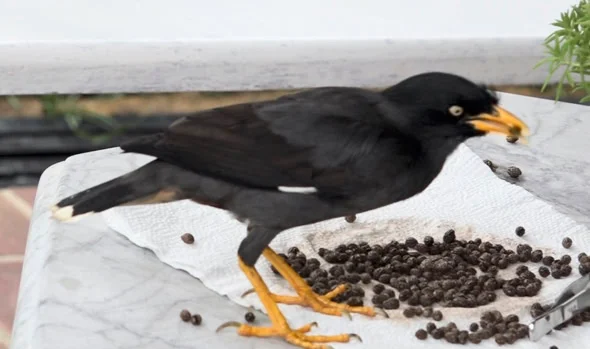


Chandigarh, May 4: The simple act of feeding birds is a profound, accessible form of quiet resistance. What appears to be a minor chore—filling a plastic tube with sunflower seeds or scattering grain on a balcony—is, in reality, a bridge between the frantic human experience and the rhythmic, grounding pulse of the natural world.
The peace found in feeding birds is not merely a poetic sentiment; it is a multi-dimensional restorative practice rooted in history, psychology, and the fundamental human need for connection.
One of the most immediate benefits of bird feeding is the way it enforces a “micro-moment” of presence. To watch birds, one must be relatively still. This forced pause creates a natural break from the “urgent” tasks of the day.
Psychologists often refer to this as soft fascination. Unlike the “hard fascination” required to navigate traffic or respond to emails—which drains our mental energy—watching the dynamic yet non-threatening movements of birds allows our directed attention to rest. As a goldfinch flits from a branch to a feeder, or a sparrow meticulously sorts through seeds, the observer is drawn into a state of mindfulness. You aren’t just looking at a bird; you are noticing the twitch of a wing, the texture of feathers, and the alertness of a creature that lives entirely in the “now.”
There is a unique emotional satisfaction in being a provider. In a society where we often feel like small cogs in large, uncontrollable systems, feeding birds offers a tangible sense of agency. You are directly supporting the survival of a living being.
Scientific studies, including those by the German Center for Integrative Biodiversity Research, have found a direct correlation between bird diversity and human life satisfaction. One study remarkably suggested that seeing 10% more bird species can generate a level of happiness comparable to a similar increase in income. This “happiness dividend” comes from the realization that we are part of a larger, healthy ecosystem. By feeding them, we move from being observers of nature to active participants in its welfare.
The peace found in this act is not a modern discovery. In ancient Hindu traditions, the practice of bhutayajna—providing food for birds and other creatures—was a daily ritual intended to balance negative karma and show gratitude to the universe. It was understood thousands of years ago that by feeding the wild, we nourish our own spirits.
In many cultures, the presence of birds is seen as a sign of a “living” home. Vastu Shastra and other traditional architectural philosophies suggest that the song and movement of birds balance the energy of a living space, inviting harmony and prosperity. Whether viewed through a spiritual or a decorative lens, a home with a bird feeder is a home that has made space for something other than itself.
The tranquility of bird feeding isn’t just visual; it is auditory. Research from institutions like Cal Poly has shown that listening to birdsong significantly improves mood and helps the brain recover from cognitive fatigue.
Birdsong serves as a “biological trigger” that signals a safe environment. Throughout human evolution, a silent forest often signaled the presence of a predator, while a forest filled with birdsong indicated safety and the presence of resources. When we attract birds to our windows, we are effectively surrounding ourselves with an ancient, subconscious “all-clear” signal that tells our nervous system it is okay to relax.
Finding Your “Bird Feeder Moment”
You do not need a vast garden or expensive equipment to access this peace. A simple window-mounted tray or a handful of grain on a park bench is enough. The key to the “peace of the feeder” lies in three things:
Consistency: The birds will learn your schedule, and in turn, their arrival will become a reliable rhythm in your day.
Observation: Challenge yourself to notice one new detail each day—the way a nuthatch climbs downward or how a chickadee takes a single seed to a nearby branch to crack it open.
Selfless Giving: Embrace the fact that the birds do not “owe” you anything. The reward is the sight of them, the sound of them, and the knowledge that for a few minutes, you have stepped out of your own head and into the sky.
In the end, we don’t just feed the birds to keep them alive. We feed them because their presence reminds us that life, in its simplest form, is beautiful, resilient, and worth paying attention to.