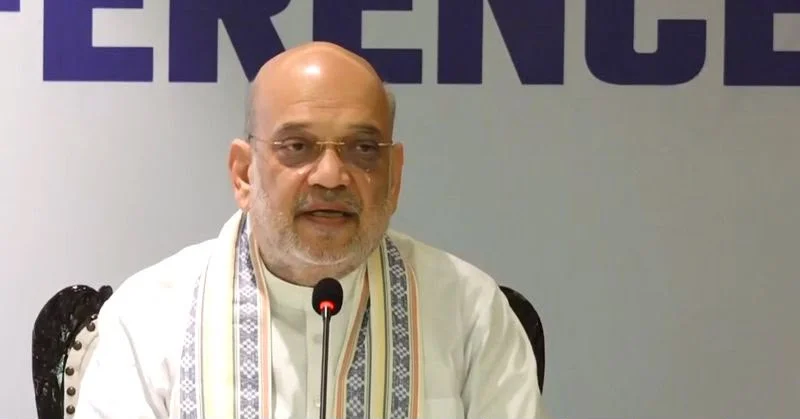


Mumbai, September 13: Union Home Minister Amit Shah on Sunday said that the decolonisation of India’s history and knowledge systems should not be understood as an attempt to erase the past, but as an effort to present the country’s historical journey in its entirety and from an authentic Indian perspective.
Shah made the remarks while inaugurating a manuscript exhibition at the Asiatic Society of Mumbai, where he highlighted the importance of preserving India’s centuries-old intellectual, cultural and civilisational heritage and ensuring that it reaches a wider audience in the country and abroad.
The Home Minister said India possesses an enormous repository of knowledge reflected through its manuscripts, historical records, languages, traditions, literature and intellectual traditions. He stressed that these sources must be preserved through systematic efforts and made accessible to future generations.
“Decolonisation does not mean erasing history,” Shah said, emphasising that the objective should be to bring historical facts before the world in their authentic form and through an Indian perspective.
He said that during the colonial era, systems of knowledge and structures of power were closely connected within the British framework. According to Shah, the ongoing effort is intended to free India’s knowledge traditions from that framework and advance the process of decolonisation.
“Today, we are moving forward to liberate knowledge from that and towards decolonisation,” he said.
Shah also underlined the significance of manuscripts and archival documents in understanding India’s intellectual and historical evolution. He said such valuable material should not remain restricted to libraries, museums or academic institutions, but should be brought before people in India and across the world.
The Home Minister said that India’s historical narrative must reflect the country’s own civilisational experiences, indigenous knowledge traditions and contributions across different fields. He stressed the need to preserve original historical sources so that future generations can study and understand the country’s past on the basis of authentic records.
The exhibition at the Asiatic Society showcased the importance of India’s manuscript heritage and highlighted the role of historical documents in preserving the nation’s intellectual legacy.
Shah maintained that decolonisation should be viewed as a process of restoring a complete and authentic understanding of India’s history rather than deleting, distorting or selectively presenting historical events.
His remarks come amid the Centre’s continued emphasis on documenting India’s indigenous knowledge systems, languages, cultural traditions and civilisational contributions, while encouraging wider public access to historical and archival resources.
The Home Minister’s address also brought renewed attention to the importance of manuscripts, archival collections and indigenous sources in documenting India’s long and diverse civilisational history and presenting it to audiences both within the country and internationally.