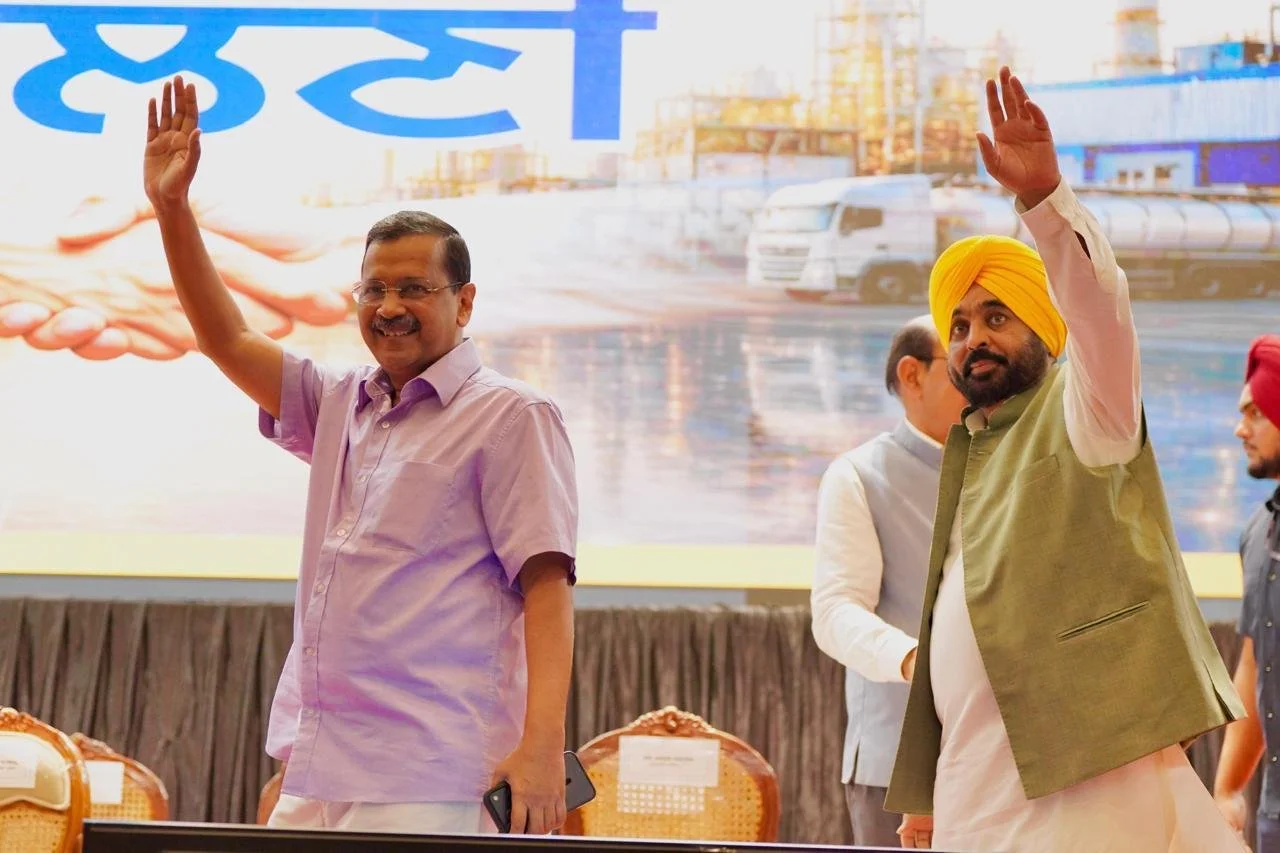


Jalandhar, June 15: The Aam Aadmi Party national convenor Arvind Kejriwal and Chief Minister Bhagwant Singh Mann directly engaged with small business owners, shopkeepers, and traders during a specialized meeting of the Punjab State Traders Commission in Jalandhar. The leadership prioritized local enterprise grievances, describing small traders as the genuine foundation of the state economy. During the interactive session, the administration sought direct feedback from the public to assess ongoing work in irrigation, employment, infrastructure, and public services.
Arvind Kejriwal shared memories of his childhood spent around his uncle’s grocery shop at a village bus stand, noting that historically, systemic economic discussions overlooked small traders in favor of massive industrial investments. To change this dynamic, the current administration established the Punjab State Traders Commission at the state, district, and constituency levels. This initiative mapped around 800 markets across Punjab to gather, document, and resolve localized structural problems. Under this framework, a dedicated team inside the Chief Minister’s Office processes complaints ranging from exposed wiring and broken roads to non-functional streetlights, toilets, and drinking water facilities.
Addressing a large gathering, Arvind Kejriwal stated that the administration functions with transparency, having ended the previous patterns of systemic extortion that plagued the business community. He contrasted this approach with other political factions, claiming that certain groups have instead weaponized central investigative bodies to collect massive donations from regional business houses through intimidation. He maintained that previous administrations allowed gangsters to thrive due to political links, whereas the current government has successfully coordinated with foreign nations to deport seven major overseas-operating criminals back to Punjab to face justice. Touching upon the drug issue, he noted that the state has deployed advanced anti-drone systems across the border to intercept cross-border smuggling, while working extensively to track the domestic transit of illegal substances originating from maritime ports in western states.
Chief Minister Bhagwant Singh Mann affirmed that the state has moved past decades of misgovernance to build a transparent, development-driven model focused entirely on public welfare. He stated that past leaders often leveraged their authority to expand personal commercial ventures, which naturally compromised public utilities like state-owned transport and government schools. He noted that traders are fundamental job creators rather than job seekers, meaning the state’s role must strictly be to facilitate business expansion without demanding unfair financial shares.
Reviewing developmental milestones, Chief Minister Bhagwant Singh Mann stated that canal water coverage for cultivable land has risen from an initial 22 percent to more than 80 percent, which successfully replenished local groundwater levels by two to four meters in multiple sectors. He declared that over 67,000 government positions have been allocated purely on merit, while the newly launched Sadak Surakhiya Force has saved more than 2,700 lives through rapid highway emergency responses. He added that nearly 90 percent of local households now receive free electricity, and the strategic state purchase of a private thermal plant will continue to provide affordable power to consumers.