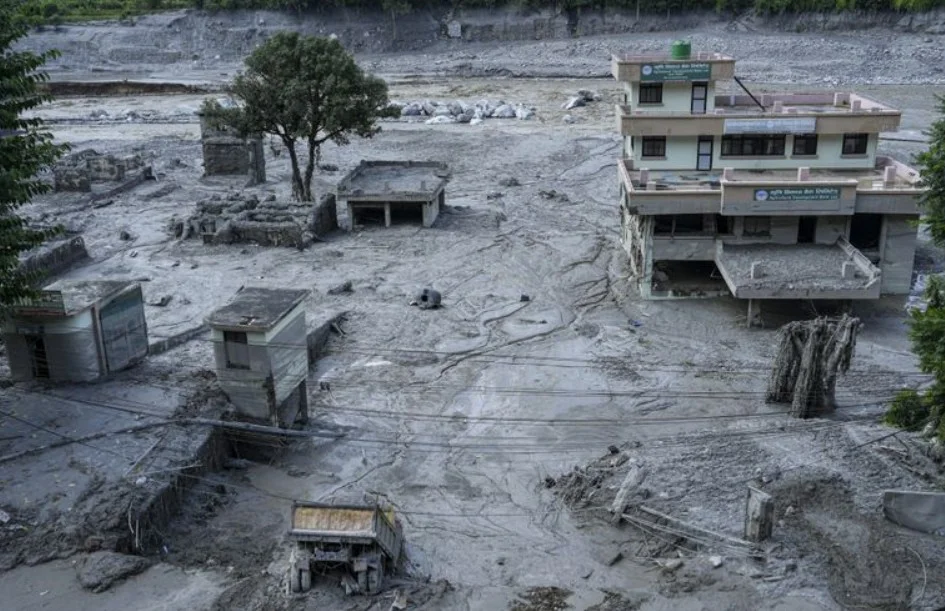


Nepalese security forces and emergency personnel cleared massive debris fields across mountain valleys today as the confirmed casualty count reached four hundred and sixty-nine following a catastrophic glacial collapse. Nearly one thousand individuals remain untraced across the mountainous region connecting Nepal and Tibet, including over five hundred foreign nationals who were traveling along popular pilgrimage and trekking routes.
Aerial teams deployed helicopters to deliver essential relief supplies and scan isolated hamlets cut off after violent torrents of ice and mud obliterated key bridges, power infrastructure, and transport links connecting Kathmandu to Lhasa.
Disaster management officials cautioned that secondary hazards pose an immediate threat to surviving communities. A dangerous artificial lake created by river-blocking debris along the Bhotekoshi corridor continues to swell, raising serious concerns of a catastrophic breach. Across the border, Chinese hydrological authorities estimated three million cubic meters of water could overflow into dammed reservoirs within days.
Zhu Jinfeng, a researcher at China’s hydrology department, affirmed that water volumes are climbing steadily, bringing a corresponding increase in operational risk for downstream areas.
The sudden deluge devastated critical transit infrastructure, including the strategic Gyirong border crossing, a core node in regional commercial routes. Emergency crews worked around the clock to clear obstructed access roads so ground support could reach severely impacted zones.
Nepal’s Prime Minister Balendra Shah asserted during an inspection of damaged districts that state agencies have mobilized at maximum capacity to prioritize life-saving efforts, search operations, and immediate humanitarian support for displaced families.
Traumatized survivors recounted the suddenness of the surge as water swept through valleys within seconds.
Dibga Tamang, airlifted to safety from Rasuwa, stated that everyone in the immediate area had perished, leaving no family members behind in the wake of total destruction.
Janak Bahadur, a survivor from Devighat, declared that the river appeared modest initially before suddenly expanding and exploding like a bomb across the terrain.
International assistance teams from India, Australia, and South Korea have joined local forces to assist with search efforts and emergency aid distribution.