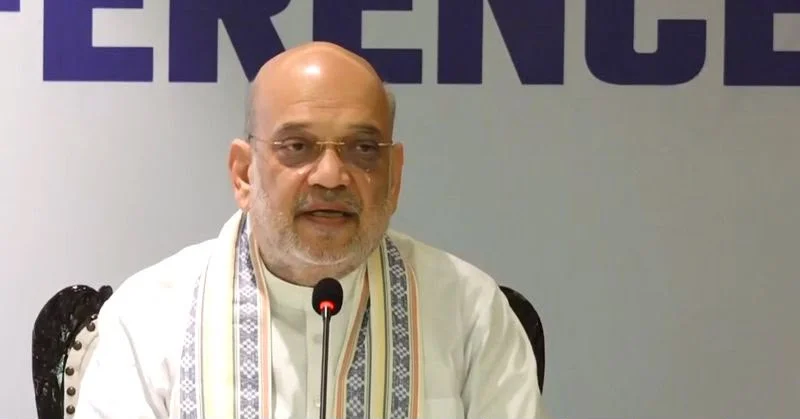


PANAJI, SEPTEMBER 6: Union Home Minister Amit Shah on Sunday announced a comprehensive three-year national roadmap to make India drug-free by 2029, stressing that protecting the country’s youth from narcotics is essential to achieving the vision of Viksit Bharat by 2047.
Addressing a press conference in Panaji after chairing a high-level meeting on narcotics, Shah said the Narendra Modi Government had transformed the fight against drugs from a conventional law-and-order challenge into a national security priority.
He said the Government’s strategy would target the entire narcotics ecosystem, including drug production, trafficking, distribution, financing and technology-enabled networks, while simultaneously strengthening prevention, treatment, rehabilitation and reintegration of victims.
Shah said Prime Minister Narendra Modi’s objective was to ensure that the country’s youth remain free from drugs and contribute actively to nation-building.
Four-Pillar Strategy for a Drug-Free India
The 2026-2029 roadmap is based on four broad pillars: intelligence- and operations-based enforcement; control of precursor and synthetic drugs; demand reduction and harm reduction; and capacity building, coordination and monitoring.
Under the strategy, enforcement agencies will undertake intelligence-led operations targeting the entire narcotics chain, from manufacturing and trafficking to financing and distribution.
The Government will also intensify action against sophisticated trafficking methods involving darknet platforms, cryptocurrency, drones, maritime routes, containerised cargo and parcel-based delivery systems.
Shah said agencies would be required to improve coordination and share information in real time to identify and dismantle organised narcotics networks.
100 Drug Networks, 100 Fugitives and 100 Labs Targeted
As part of the three-year campaign, the Government has fixed specific targets to:Dismantle 100 international and inter-State drug networks.Bring 100 narcotics-related fugitives back to India.Destroy 100 clandestine drug laboratories
The targets are aimed at shifting the focus from small-time offenders towards the major networks, financiers and masterminds controlling the narcotics trade.
Shah said the Government would adopt a network-centric approach to identify and dismantle the structures responsible for organising and financing drug trafficking.
Strong Focus on Synthetic Drugs and Narco-Financing
The Home Minister warned that the narcotics trade is increasingly connected with organised crime, narco-terrorism and cross-border terrorist financing.
He stressed the need for stronger financial investigations in major narcotics cases, including the identification, freezing and seizure of proceeds generated through drug trafficking.
According to Shah, enforcement agencies must move beyond merely arresting traffickers and concentrate on dismantling the financial infrastructure sustaining the illegal drug economy.
The Government will also strengthen monitoring of precursor chemicals and synthetic drugs, which have emerged as significant challenges for enforcement agencies.
‘Ruthless Against Traffickers, Compassionate Towards Victims’
Shah said the Government would adopt a ruthless approach towards drug traffickers while maintaining a sympathetic and supportive approach towards victims of substance abuse.
He stressed that young people affected by drug abuse must receive appropriate treatment, rehabilitation and opportunities for reintegration into society.
The strategy will therefore combine supply reduction, demand reduction, public awareness, treatment and rehabilitation.
Anti-Drug Campaign to Reach 50 Crore Citizens
The Government also plans to expand public participation in the anti-drug campaign by reaching around 50 crore citizens across the country.
It aims to create one lakh ‘Nasha Mukt Mitras’ who can contribute to awareness, prevention and community-level efforts against substance abuse.
The number of de-addiction centres is also planned to be increased to 1,751, strengthening the country’s treatment and rehabilitation infrastructure.
Shah said the fight against drugs could not be won by enforcement agencies alone and required a whole-of-government and whole-of-society approach, involving Central and State Governments, educational institutions, communities, youth and civil society organisations.
Over 1.19 Crore Kg of Drugs Seized Since 2014
According to figures cited by the Government, more than 1.19 crore kilograms of narcotic substances, valued at approximately ₹1.89 lakh crore, were seized between 2014 and 2024.
During the same period, more than 48.66 lakh kilograms of drugs were destroyed, the Government said.
Measures have also been introduced to accelerate the disposal of seized narcotics and improve coordination among various enforcement agencies.
Narcotics Declared an Internal Security Challenge
Shah said the narcotics menace posed a threat not only to public health, but also to India’s internal security, economic interests and social stability.
He pointed out that criminal networks were increasingly using modern technology and multiple channels to transport and distribute drugs.
These include drones, maritime routes, containerised cargo, darknet platforms, cryptocurrency transactions and parcel networks.
He said India’s response must consequently be technology-driven, intelligence-led and coordinated.
Jammu and Kashmir and Northeast Also Highlighted
During his address, Shah also referred to the internal security situation in Jammu and Kashmir and the Northeast, saying that terrorism in Jammu and Kashmir had declined and the security situation in the Northeast had improved.
He said the Government had adopted a determined approach against Naxalism and would pursue a similarly firm strategy against the narcotics menace.
Shah also highlighted the return of thousands of young people in the Northeast to the mainstream after giving up arms, while asserting that the long-standing challenge of Naxalism had been brought to an end.
Roadmap to Be Reviewed After One Year
The Government’s 2026-2029 Vision Document on Drug Control provides a time-bound framework covering enforcement, supply reduction, demand reduction, rehabilitation, synthetic drugs, darknet-enabled trafficking, youth awareness and inter-agency coordination.
Shah said implementation of the roadmap would be reviewed after one year, following which necessary modifications would be made for the remaining two years of the programme.
He called upon the Centre, States, enforcement agencies and citizens to work collectively towards achieving the goal of a Nasha Mukt Bharat.
The Home Minister maintained that defeating the narcotics menace was crucial not only for protecting India’s youth but also for strengthening national security, social stability and the country’s long-term development.