

By Dr. Shirish Mishra
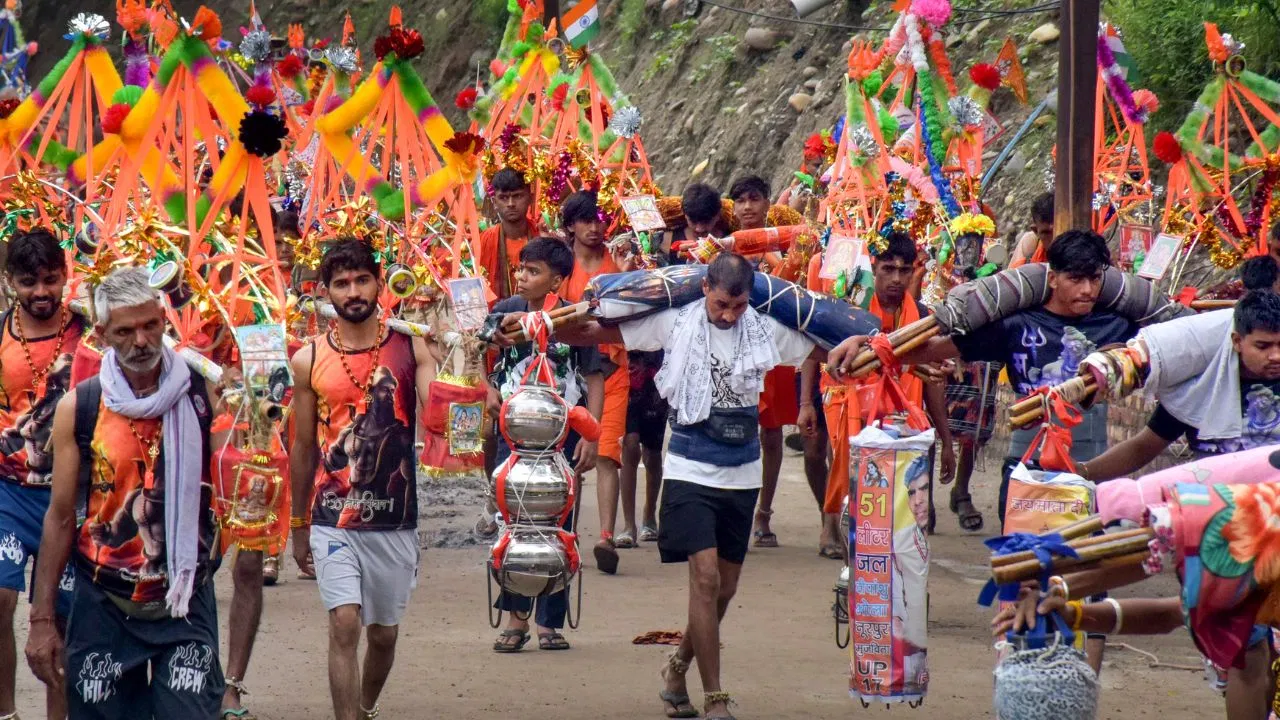
The month of Shravan has begun, and saffron-clad Kanwariyas have started appearing on the roads of Uttar Pradesh, especially across the western districts. Carrying Kanwars resting on their shoulders with vessels filled with Gangajal, and with streets echoing to chants of “Bol Bam” and “Har Har Mahadev,” the atmosphere presents a living spectacle of Indian folk faith. This journey is not merely a religious ritual, but a confluence of Sanatan sentiments that unite with Lord Shiva at the center.
Recognizing the significance of this festival of devotion, the state government stands in reverence before these devotees of Aughad Dani. From drone surveillance to helicopter flower showers, and from temporary hospitals to the repair of thousands of kilometers of roads, the pilgrimage is viewed not simply as a religious event, but as a major platform to demonstrate administrative respect for governance, social identity, and public faith. As Chief Minister Yogi Adityanath demonstrates reverence for these Kanwariyas, the gesture carries deeper implications rooted in ancient tradition.
The Mythological Roots of the Tradition
No single scripture, Veda, or Purana outlines a systematic reference detailing when or how the Kanwar Yatra began. Instead, it is a collective tradition of faith that evolved through the amalgamation of numerous mythological narratives and folk legends.
The most widely known account traces back to the Samudra Manthan. According to mythological narrative, when the Devas and Asuras churned the ocean, the deadly poison Halahal emerged, threatening creation. To protect the universe, Lord Shiva consumed the poison and held it in his throat, which turned blue and earned him the name “Neelkanth.” To pacify the intense heat generated in his body, the Devas performed his Abhishek with Gangajal. Based on this belief, devotees offer Ganga water to the Shivling during Shravan as a symbol of devotion and gratitude.
Other legends also point toward the ancient origins of the tradition:
Ravana’s Devotion: Popular belief holds that Ravana brought Gangajal from Haridwar to establish a Shivling at Pura Mahadev in Baghpat, performing its Jalabhishek—regarded by many as the earliest reference to the pilgrimage.
Lord Parashuram: Accounts state that Lord Parashuram carried Gangajal from Garhmukteshwar to perform Jalabhishek at Pura Mahadev.
Shravan Kumar: While his story involves carrying his blind parents in a Kanwar on a pilgrimage, it firmly established the Kanwar as an enduring symbol of service, sacrifice, and dedication.
Across all these narratives runs a common thread: the sanctity of Gangajal, unwavering devotion to Lord Shiva, and the aspiration for spiritual purification through penance.
Evolution into a Modern Public Movement
Over time, the tradition of Jalabhishek evolved into an organized socio-religious event. After Independence, the yatra was largely limited to a small number of saints, seers, and elderly devotees undertaking the journey on foot. Past administrations generally viewed it strictly as a quiet religious ritual.
However, over the past decade, the yatra has transformed into a symbol of social identity, collective enthusiasm, and religious consciousness. Today, crores of devotees from across the country participate annually, making it one of the largest annual pilgrimages in the world.
This expansion gained further momentum after 2017, when Chief Minister Yogi Adityanath linked the movement of devotees directly to administrative duties—encompassing law and order, traffic management, healthcare, and security.
The Three Implications of State Support
The modern management of the Kanwar Yatra carries three distinct dimensions:
- Administrative Responsibility: Ensuring the safety, sanitation, and health of crores of citizens—through CCTV surveillance, medical camps, alternative traffic routing, and heavy police deployment—fulfills a fundamental duty of the state during large-scale public gatherings.
- Socio-Political Resonance: Extending structural support to the event aligns governance with the cultural sentiments and heritage of the majority community, reinforcing cultural identity.
- Economic Impact: The massive influx of devotees sustains a temporary economic ecosystem, benefiting local shopkeepers, dhaba operators, service camps, and small vendors along the route.
In essence, the Kanwar Yatra reflects the collective memory of Indian society, weaving together mythological narratives, folk beliefs, and social unity. As ancient faith meets modern administration, the pilgrimage continues to showcase the social significance of the Yatra and the enduring essence of Sanatan culture.