

AMRITSAR, May 18, 2026 – The Punjab government has reaffirmed its long-standing legal position before the Ravi and Beas Waters Tribunal, asserting that it cannot provide any additional water resources to Haryana or Rajasthan because neither state falls within the actual river basin geography.
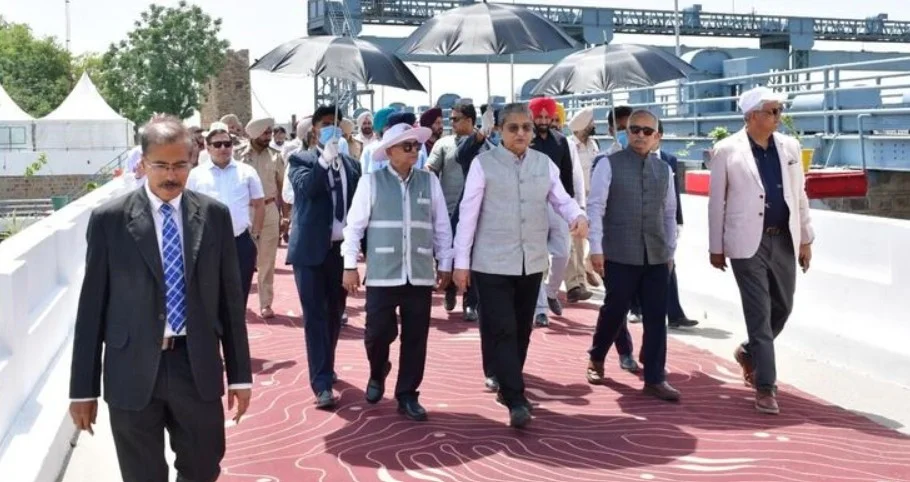
During a formal two-day assessment tour by the three-member judicial panel, state legal and administrative representatives stated that the hydrological ecosystem of the Ravi and Beas rivers belongs exclusively to Punjab, Himachal Pradesh, and Jammu and Kashmir. The government showcased its current water management system to the delegation, led by retired Supreme Court Judge Justice Vineet Saran, utilizing state air transport to facilitate inspections of primary canal systems in the Ferozepur and Harike sectors.
Chief Minister Bhagwant Singh Mann met with the panel members in Amritsar to outline local conservation initiatives. Mann stated that the provincial executive has altered distribution protocols to guarantee that canal water reaches farmlands situated at the extreme tail-ends of the state’s irrigation grid.
“The government is ensuring canal water reaches farmers at the tail-end areas to reduce groundwater extraction and prevent desertification,” Mann stated.
Technical experts from the Water Resources Department presented historical data arguing that Punjab’s water baseline has suffered severe depletion since the mid-20th century. Analysts noted that prior to Partition, the undivided territory commanded 176.37 million acre-feet (MAF) of water. Following the geopolitical re-alignments and subsequent state reorganizations, Punjab’s share from the eastern rivers of the Indus system dwindled to 15.14 MAF.
State administrators asserted that of the 15.85 MAF currently generated by the Ravi and Beas rivers, Rajasthan draws 8.8 MAF and Haryana receives 3.5 MAF, leaving Punjab with 4.22 MAF. The delegation noted that while non-basin states secure substantial allocations, Punjab has been excluded from accessing the Yamuna river framework, forcing local engineers to deactivate multiple regional canals due to systemic volume deficits.
The itinerary included inspections of the Luther Canal system in Ferozepur, where local teams presented evidence of cross-border ecological damage. Officials noted that chemical effluents discharged from leather manufacturing clusters in Kasur, Pakistan, have heavily contaminated the Sutlej river feed, complicating public health and farming operations along the international border.