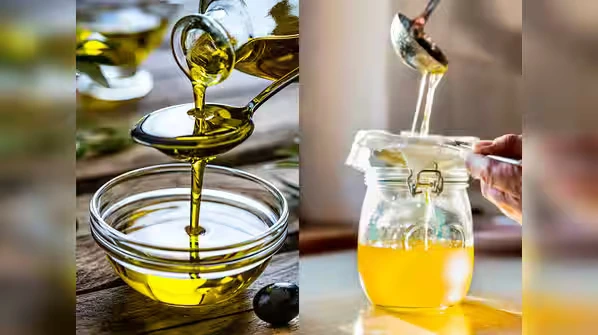



Chandigarh, Oct 12: For decades, traditional cooking fats like desi ghee were demonized by dietary trends that advocated for seed and vegetable oils. Touted as “heart-healthy” alternatives, industrial refined oils quickly replaced traditional clarify butter in millions of kitchens worldwide.
However, modern nutritional science—alongside ancient Ayurvedic wisdom—has sparked a significant re-evaluation. Today, evidence increasingly demonstrates that pure desi ghee is not only superior to refined cooking oils in thermal stability and gut health benefits, but it also serves as a far more wholesome nutrient source when consumed in moderation.
One of the main arguments for choosing ghee over cooking oils lies in its remarkable chemical stability at high temperatures. Ghee boasts an exceptionally high smoke point—around ().
When vegetable or seed oils are heated past their smoke points during Indian-style frying, sautéing, or tempering (tadka), they oxidise and break down, forming toxic free radicals, lipid peroxides, and harmful acrylamides.
In contrast, because ghee is made predominantly of stable saturated fats that lack easily oxidizable double bonds, it resists heat-induced damage. Cooking with ghee ensures that your meal remains free of toxic compounds caused by thermal degradation.
Elimination of Industrial Processing and Trans Fats
Refined vegetable oils—such as soybean, sunflower, canola, and palm oil—undergo extreme industrial processing involving chemical solvents, bleaching agents, and high-heat deodorization.
This heavy refining destroys natural antioxidants and often introduces synthetic additives or dangerous trans fats, which are linked to chronic systemic inflammation and cardiovascular disease.
Conversely, authentic ghee is a minimally processed, natural food. Traditional methods involve simmering cultured butter to evaporate water and separate milk solids, leaving behind pure liquid gold. Ghee contains zero artificial chemical residues and zero inflammatory trans fats. Furthermore, because the milk solids (lactose and casein) are strained out during preparation, pure ghee is naturally allergen-friendly and easily tolerated by lactose-intolerant individuals.
A Gut-Healing Powerhouse Rich in Butyrate
Unlike plant-based oils, ghee is one of the richest natural sources of butyric acid (butyrate), a short-chain fatty acid that serves as the primary energy source for the cells lining the human colon.
Butyric acid helps maintain gut lining integrity, reduces internal inflammation, aids digestion, and supports a balanced microbiome. No vegetable or seed oil provides butyrate.
While refined oils lose most of their micronutrients during processing, pure cow ghee acts as a natural delivery vehicle for critical fat-soluble vitamins: A, D, E, and K2. Vitamin K2, in particular, plays a vital role in directing calcium into bones and teeth while preventing calcium build-up in blood vessels and arteries.
Additionally, the natural fats in ghee help the human body absorb fat-soluble nutrients from accompanying vegetables, lentils, and spices far more efficiently than highly processed oils.
While portion control remains important for any fat source, replacing chemically processed refined oils with pure desi ghee is a powerful step toward reclaiming whole-food nutrition. With its high heat tolerance, gut-nourishing butyrate content, rich vitamin profile, and absence of industrial trans fats, ghee easily proves itself to be the superior choice for everyday cooking.