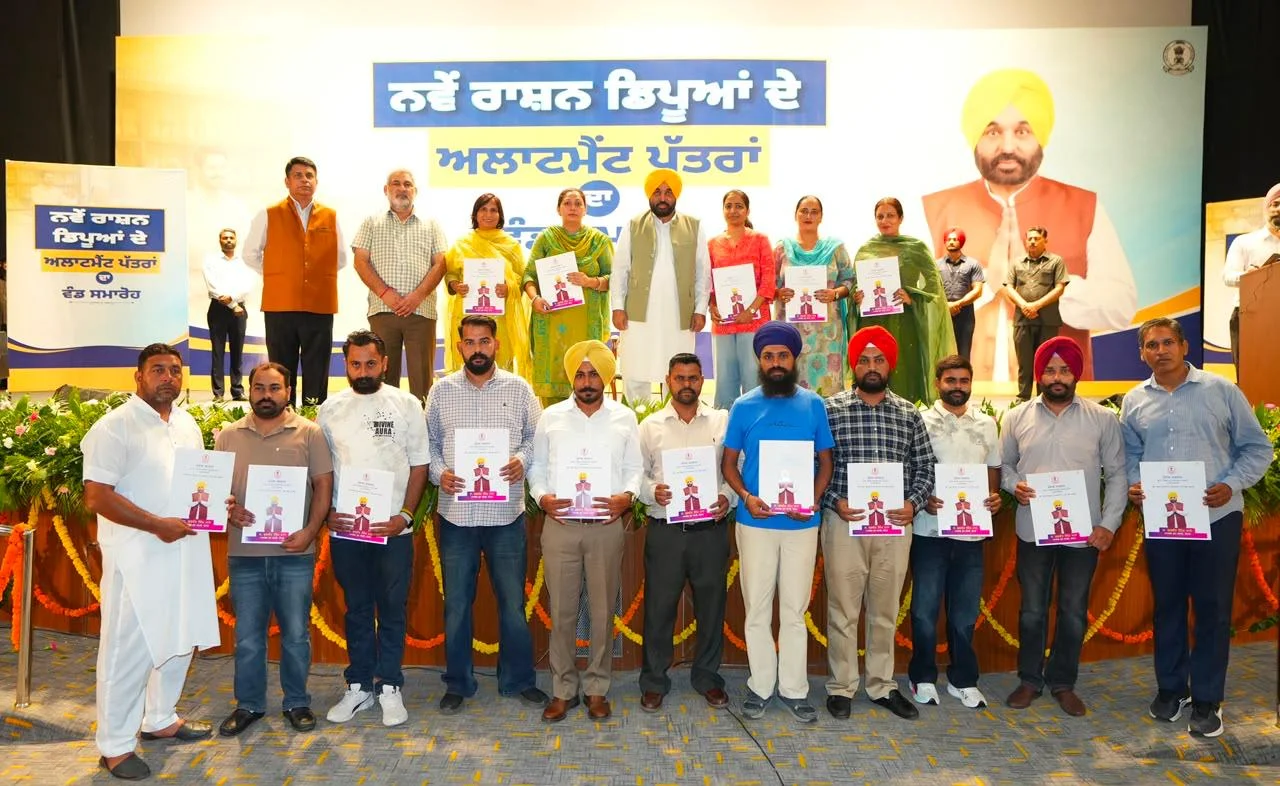


SAS NAGAR (MOHALI), July 17 — The state administration has drastically reduced the travel distance for five and a half lakh essential food supply beneficiaries by issuing operational authorization to 2,800 new ration depot operators. This systematic expansion of the decentralized public distribution infrastructure is designed to ensure that ordinary citizens no longer have to sacrifice daily wages or endure long queues at distant storage facilities to claim their state allocations. Chief Minister Bhagwant Singh Mann distributed the new official documentation during a specialized state assembly held at Vikas Bhawan on Thursday, positioning the structural upgrades as a major advance in public convenience.
The allocation framework mirrors the inclusive social engineering goals of the current administration, ensuring formal economic opportunities for previously underserved communities. Official state data shows that the 2,800 newly designated storage centers include 633 facilities managed by Scheduled Castes, 199 by Other Backward Classes, 181 by ex-servicemen, 156 by persons with disabilities, 39 by the descendants of freedom fighters, and 17 by families impacted by past riots.
“The allotment has been made in a fair and transparent manner while ensuring representation for every section of society,” Chief Minister Bhagwant Singh Mann declared during the certificate distribution event. He affirmed that the new framework completely eliminates the outdated practice of political patronage.
The structural transition introduces an objective, interview-based evaluation mechanism to verify the competence and community commitment of the selected operators. Administrative reviews indicate that this updated strategy guarantees an uncompromised level of systemic accountability while providing respectable employment to thousands of local households. Under the ongoing Smart Ration Card Scheme, the administration continues to manage the free distribution of high-quality wheat alongside specialized Meri Rasoi ration kits to roughly 40 lakh families statewide.
“The earlier governments distributed ration depot licences on the basis of political recommendations,” the Chief Minister asserted. “We have ended that practice by introducing an interview-based selection system to eliminate favouritism and ensure complete transparency.”
The newly inducted distribution partners have received specific instructions to prioritize weak, vulnerable, and elderly consumers, with provisions for direct home delivery where mobility challenges exist. Alongside updates to the food sector, the state continues to advance its rural development goals through expanded irrigation networks. Recent central indicators show that the state’s focused shift toward utilizing surface canal channels has effectively boosted regional water tables by nearly four meters since 2022, systematically decreasing operational pressure on declining subterranean water reserves.