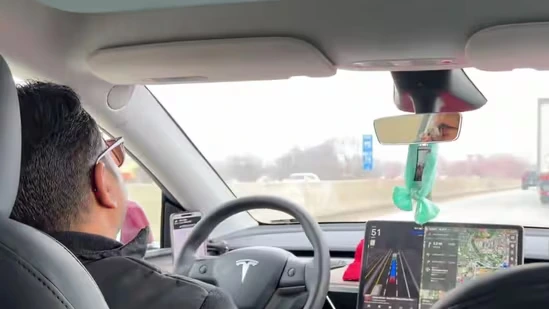


Washington, May 21: A video capturing an Uber driver asleep at the wheel of a Tesla while the vehicle navigated a highway via its Full Self-Driving system went viral online, triggering a renewed public debate regarding the safety and limits of automated driving technology.
The footage, recorded and posted on the X platform by an American passenger using the handle @boostedboikyle, shows the driver completely unconscious for the vast majority of a 20-minute highway journey. Despite the driver’s total lack of situational awareness, the vehicle managed to follow its navigation path, execute highway lane changes, exit the freeway, and deliver the passenger to the designated destination without any physical intervention.
While the passenger expressed personal confidence in the automated system, the documentation generated significant criticism from digital safety advocates and consumer groups who noted that the scenario violated basic operating standards.
“My uber picked me up in a Tesla and fell asleep on the highway,” the passenger noted in the public post accompanying the video clip. “I’ve driven with FSD and trust how well it works so I wasn’t worried. It took the exit and drove me to my destination all by itself. He was asleep for 90% of the 20 minute drive.”
The recorded footage shows the vehicle maintaining a steady highway cruise speed while automated dashboard displays processed real-time map data, all while commercial music played in the background of the silent cabin.
The incident drew immediate rebukes from transportation analysts who highlighted the extreme physical risks associated with unexpected human re-intervention during automated transit sequences.
“I would never trust this,” one online commentator stated, echoing a sentiment shared by several passenger safety advocates. “What if he wakes up, gets scared, and jerks the steering wheel? I’d trust it more without a person there at all.”
Industry experts observed that such incidents could accelerate the deployment of fully driverless autonomous taxi networks, as ride-hailing firms seek to eliminate liability risks tied to human operator fatigue.
“This is what FSD was NOT meant for,” another analyst noted regarding the operational boundaries of the software. “By doing this, this driver will soon be replaced. AI cabs are coming to major cities, then these Uber drivers will be up in arms. Well, this is the case study.”
Current regulatory frameworks for driver-assist programs explicitly require the human operator to maintain active visual focus and keep their hands on the steering mechanism at all times to intervene instantly during mechanical or software miscalculations.